Posted on 22 September 2008 by Tenth Amendment
by Rep Ron Paul
On September 10, 2002 I asked 35 questions regarding war with Iraq. The war resolution passed on October 16, 2002. Now today, as some of my colleagues try to reestablish credentials regarding spending restraint, I want to call attention to my 18th question from six years ago:
“Are we willing to bear the economic burden of a 100 billion dollar war against Iraq, with oil prices expected to skyrocket and further rattle an already shaky American economy? How about an estimated 30 year occupation of Iraq that some have deemed necessary to “build democracy” there?”
Many scoffed at my “radical” predictions at the time, regarding them as hyperbole. Six years later, I am forced to admit that I was wrong. My “radical” predictions were in fact, not “radical” enough. Continue Reading
Posted on 01 September 2008 by Tenth Amendment
by Rep Ron Paul
Many who agree with me on a lot of other issues, do not understand my enthusiasm for gold and sound money or why I spend so much time studying and talking about monetary policy. It’s true that I talk about money differently than most, but the fact is sound money offers many benefits.
For example – peace. Continue Reading
Posted on 14 July 2008 by Tenth Amendment
by Rep Ron Paul
What will it take to get our troops out of Iraq? The roughly 70 percent of Americans who are firmly against the war often ask this question. Those in power are reluctant to give conditions, but when they do and those conditions are met, the goal post is quietly moved.
Voters were promised, passionately and vehemently, that the new Congress would bring our troops home. Many were explicitly elected in 2006 under that banner. But our troops are still overseas, funding has been increased even beyond the administration’s wish list, and troop withdrawal has been negotiated away. Continue Reading
Posted on 12 July 2008 by Tenth Amendment
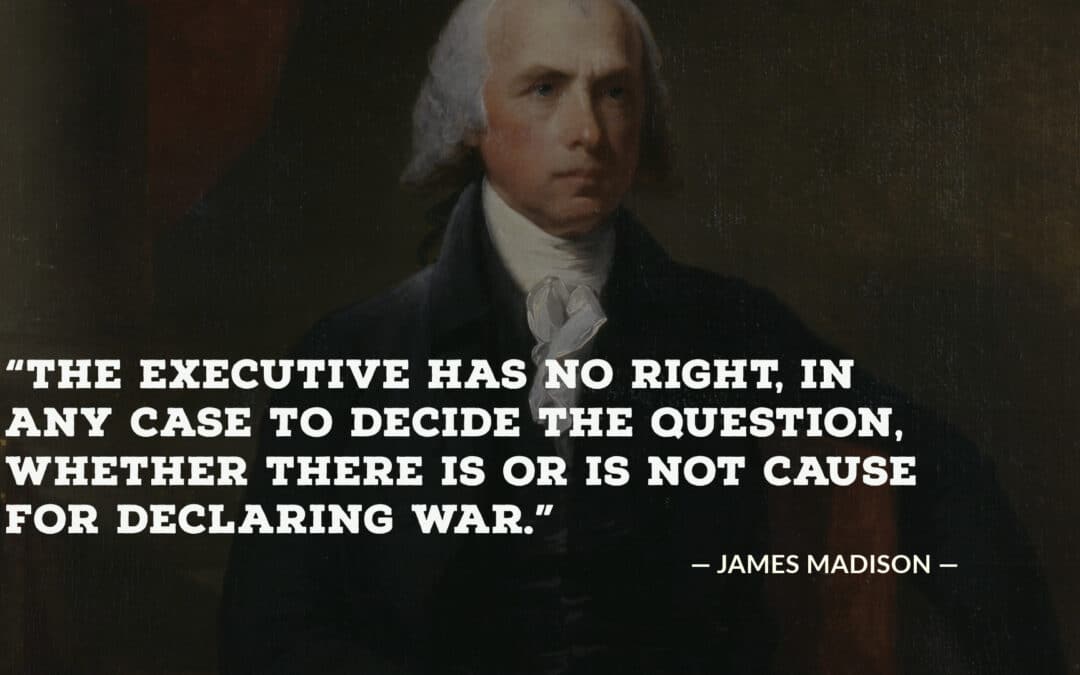
The framers of the Constitution attempted to balance the power of the President as commander-in-chief with that of Congress, the representatives of the People.
Article II, Section 2 of the Constitution gives to the Executive Branch the command of the nation’s armed forces, while Article I, Section 8 gives to the Legislative Branch the power to decide when the United States goes to war. Continue Reading
Posted on 19 June 2008 by Tenth Amendment
by Rep Ron Paul
What is the importance of the war in Iraq relative to other current issues? This is a question I am often asked, especially as Americans continue to become increasingly aware that something is very wrong with the economy. The difficulty with the way the question is often asked relates to the perception that we are somehow able to divide such issues, or to isolate the cost of war into arbitrarily defined areas such as national security or international relations.
War is an all-encompassing governmental activity. The impact of war on our ability to defend ourselves from future attack, and upon America ’s standing in the world, is only a mere fraction of the total overall effect that war has on our nation and the policies of its government. Continue Reading
Posted on 19 May 2008 by Tenth Amendment
by Rep Ron Paul
This week, as the American economy continued to suffer the effects of big government, the House attempted to pass two multibillion dollar “emergency” spending bills, one for continued spending on the war in Iraq , and one increasing spending on domestic and international welfare programs. The plan was to pass these two bills and then send them to the president as one package.
Even though the House failed to pass the war spending bill, opponents of the war should not be fooled into believing this vote signals a long term change in policy. At the end of the day, those favoring continued military occupation of Iraq will receive every penny they are requesting and more as long as they agree to dramatically increase domestic and international welfare spending as well. Continue Reading
Posted on 08 February 2008 by Tenth Amendment
Guest Commentary by Dan Reale
You can ask anybody what the first amendment prevents infringement upon. They might know about one thing, freedom of speech, but incorrectly, tell you we are granted freedom of speech. Even then, most miss the other four inalienable rights the Constitution limits the federal government from violating.
Most are equally unaware of the right of the people to keep and bear arms, and even of their status as militia under U.S. code. Most also don’t know that the third amendment prevents forced slumber parties with soldiers, and further assume that one’s right to be secure in his papers, person and effects can be waived by law – without a rebellion or invasion. They also believe that the seizure of life, liberty or property is okay without a warrant, just compensation or due process is legal. Continue Reading
Posted on 28 September 2007 by Tenth Amendment
Yesterday, as the Senate overwhelmingly voted for the Lieberman-Kyl Amendment on Iran, I couldn’t stop my amazement at the absolute arrogance of the US federal government.
The amendment states: “The United State should designate Iran’s Islamic Revolutionary Guards Corps as a foreign terrorist organization . . . and place the Islamic Revolutionary Guards Corps on the list of Specially Designated Global Terrorists.”
Continue Reading
Posted on 24 September 2007 by Tenth Amendment
Just focusing on the economics of it all, the wars in Iraq and Afghanistan are estimated to cost nearly $200 Billion in 2008. And, if we assume the government will act like it normally does, you can expect that price tag to be far, far higher than what they claim it will be. Continue Reading
Posted on 19 September 2007 by Tenth Amendment
Cindy Sheehan, writing in an article titled “At What Price, Safety?“ at Buzzflash today made some excellent points arguing against the use of aggression by the US military against the people of Iraq. She, like many others, realizes that the illusion of security that the federal government claims to provide could never justify its current actions - killing, violations of liberty and the like. Continue Reading