Tag Archive | "War Powers"

Tags: , ,

The Sovereign Presidency: Is This What the Framers Had in Mind?

Posted on 20 September 2009 by Tenth Amendment

by Joseph R. Stromberg, The Freeman

American government under the Constitution was supposedly meant to work as follows: Congress, staying within delegated powers and the Bill of Rights, passes laws; the president executes the laws; and the courts sort out ensuing wrangles. This plan ran aground rather early—the 1798 Alien and Sedition Acts, for example—which raises at least two possibilities: 1) The Federalist movement systematically misrepresented its project or 2) the framers’ well-meant “design” fell short of their goals. Figuring this out is difficult, with original sin, human nature, foreign complications, and more tangling up the causal chain.

Even so, the Constitution—read anywhere near its apparent intent—might be worth hanging onto; but how can we get such a reading? Enter a new crop of “conservative” legalists to offer us one under the rubric of “originalism.”

For this crop of presidentialists, which includes John C. Yoo, Roger J. Delahunty, David Addington, Jay S. Bybee, and Attorney General Alberto Gonzales, originalism centers on the Unitary Executive Theory (UET)—a bizarre doctrine of presidential infallibility allegedly prefigured by Alexander Hamilton. Under the UET, America ’s president is utterly sovereign in his sphere and sole judge of his own powers.

The merest glance at America ’s founding suggests that no one really wanted full-bore elective despotism. Nonetheless, American presidentialists apparently find just that in the terms “war powers” and “commander-in-chief,” and in presidential dominance of foreign affairs. Yet their forebear Hamilton conceded that in war the president has “nothing more than the supreme command and direction of the military and naval forces, as first General and Admiral of the Confederacy” (Federalist 69).

Presidentialists take John Marshall’s comment, in Congress, that the president is our “sole organ of communication” with other nations as entailing lots of power. And always, presidents assert powers and store up precedents. Presidentialists turn presidential duties, chores, and everyday practices into powers, and strong figures have built the office. In the Mexican War (1846–48), President James Polk established the practical precedent of maneuvering Congress into war. But it was Abraham Lincoln, above all, who asserted immeasurable war powers belonging (mostly) to the president, by combining the commander-in-chief clause with the president’s job of enforcing the laws. Of this, legal historian Raoul Berger writes in Executive Privilege: “[W]hen nothing is added to nothing the sum remains nothing.” But success succeeds, and later presidents— Richard Nixon and George W. Bush among them—have eagerly wrapped themselves in Lincoln ’s mantle of effectively suspending the Constitution to save the country.

After Lincoln, presidential war powers rested up until 1898, when President William McKinley wielded them overseas. (McKinley issued a virtual ultimatum to Spain over Cuba a month before Congress declared war.) Theodore Roosevelt thought he could do anything not prohibited, at home and abroad, thereby neatly reversing the premise on which the Constitution was sold. Woodrow Wilson, too, had large views, but in 1917–1918 amiably shared with Congress the power of treading liberty under foot (conscription, for example), albeit with no new doctrines, merely existing bad ones.

Worse luck, in United States v. Curtiss-Wright Export Co. (1936), conservative Supreme Court Justice George Sutherland fancied that during our revolution, George III’s prerogative powers somehow lighted on the union, hovering, extra-constitutionally, above successive Congresses, descending finally on the presidency. Berger deconstructed Curtiss-Wright, underscoring the break with England and the resulting institutional discontinuity. Sutherland’s opinion stands, approvingly cited by UE theorists.

As Berger notes, Sutherland championed “a theory of inherent presidential power over foreign relations.” Berger quotes Louis Henkin, who adds that Sutherland’s assertion “carves a broad exception in the historic conception . . . never questioned and explicitly reaffirmed in the Tenth Amendment, that the federal government is one of enumerated powers only.”

Presidential power made great strides under Franklin Roosevelt, before and during World War II. FDR’s domestic emergencies and his wartime operations added much to the office. The Cold War extended these power-accumulations into an indefinite and interesting future.

The Supreme Court’s decision in Youngstown Sheet & Tube Co. v. Sawyer (1952), during the Korean War, reflected existing realities. Briefly, President Harry Truman, citing war powers, seized the steel industry to end a strike. People across the political spectrum, from organized labor to Republican Senator Robert Taft, denounced the action. The Supreme Court dodged the issue, holding that presidential powers did not go quite as far as Truman thought.

Bottomless Well of Power

Presidentialists take “The executive power shall be vested” (Article II) for a bottomless well. They see the specific duties mentioned as additional grants of power open to further (perhaps tortured) interpretation. They find further “inherent powers” arising from international law and Marshall’s sole organhood, and read the oath—“faithfully execute the office” and “preserve, protect, and defend the Constitution”—as allowing the president to violate laws in defense of the Constitution. Yet the charge that the president “take care that the laws be faithfully executed”(Article II, Section 3) seems to prohibit such maneuvers, although presidents have bent the words to their purposes, as when Lincoln “combined” them with the commander-in-chief provision.

Presidential lawyers aggregate or separate clauses to widen power. Political scientist Richard M. Pious writes in American Presidency that presidential lawyers, construing congressional powers strictly, view “all remaining functions, powers, and duties [as] exercised by the president under doctrines of inherent powers, resulting powers, sovereign powers, and inclusions”—along with emergency and national-security powers. Finally, presidents—as a branch of government—assert a right to interpret the Constitution. Pious shows minimal respect for these notions, commenting that recent, barely elected presidents have felt a need to exploit their “legal” opportunities.

From 1947 on, anticommunist crusading fostered right-wing presidentialism. Meanwhile, on other issues the Supreme Court provoked a reaction toward strict construction. Since that was quite incompatible with Cold War policies, something had to give; when it did, right-wing presidentialists hijacked strict construction, reinventing it as absolutist originalism. Midway through this journey, Richard Nixon’s cries of “national security”—to becloud the Watergate affair—rang like a fire bell in the day.

In his online paper “Rethinking Presidential Power—The Unitary Executive and the George W. Bush Presidency,” political scientist Christopher S. Kelley writes that, frustrated by ongoing congressional “aggression” against executive power—the War Powers Act of 1973 and congressional “interference” with federal bureaucracies—lawyers in the Justice Department’s Office of Legal Counsel cobbled UE theory together in the 1980s. During war—as everyone “knows”—the feds may freeze the Bill of Rights, provided they thaw it out later. What seems new in UE theory is the assertion that the president is sole judge of his powers, with Congress and courts excluded from inquiring into executive undertakings. (Nixon claimed to be sole judge of executive privilege.) This would seem a recipe for tyranny.

UE theorists speak of constitutional text, structure, and history; but their postmodern textual maneuvers, their homemade structures, and their lawyer’s history live on the edge of sudden implosion. In a 2003 paper, “Judicial Review and the War on Terrorism,” John Yoo, who had worked in the Bush 43 Office of Legal Counsel, asserted that while the judicial process exists for issues involving federalism, none exists for issues arising from war. He thereby nodded toward UE theorists’ oft-professed belief in states’ rights while separating all such “domestic” matters from important presidential activities. Yoo praised “the war powers system we have today in which the President initiates war, Congress funds it, and the courts remain aloof.” Further, the president may designate citizens as enemies, with no further proof or process needed.

Elsewhere, in “The President’s Constitutional Authority to Conduct Military Operations against Terrorist Organizations and the Nations that Harbor or Support Them,” Yoo and Roger Delahunty examine Article II of the Constitution where they see the mere words “the executive power shall be vested in a President”—the high-toned “Vesting Clause”—as unveiling a mighty fortress: “The executive power” (my emphasis). The authors assign the president “all of the executive power” and “full control“ of the military, adducing his power to “repel sudden attacks,” commending his “speed and energy.” Predictably, they hold that Congress has only powers “herein granted” and “enumerated,” while the president has “all other unenumerated powers.” Backed by “historical practice” and “precedent,” “the President alone” decides war and peace. This is textualism?

The shades of Wilson, FDR, and Truman must be smiling. Few non-White House supremacists would read texts so liberally. A whole generation of conservative constitutionalists now surpasses Earl Warren in creative writing. Some conservatives foment empire, militarism, surveillance, and presidential hubris through their own juridical and judicial activism.

Such are the raw materials of UET, but there are a few more points of interest.

Unenumerated Powers Don’t Exist

  1. Presidents reach for “all other unenumerated powers”; but by a well-known canon of construction, powers not enumerated are not “granted” and do not exist. The claim assumes the very thing to be proven. In Executive Privilege, Berger writes that, “lacking an ‘enumerated’ power, action is illegal” and observes that “faithfully executed” implies presidential accountability to Congress. Further, “executive privilege” (withholding information) asserts a power the King had already lost. He adds that “the Framers vested many prerogatives of the Crown in Congress and denied them to the President.”Berger remarks on the “meager scope” of the presidency’s projected powers: “The words ‘executive power’ were thus no more than a label designed to differentiate presidential from legislative functions, and to describe the powers thereafter conferred and enumerated. To derive additional authority from this descriptive label is to pervert the design of the Framers. . . .” Further: “Madison and [James] Wilson stated that the rights of ‘war and peace,’ enjoyed by the King, were not included in the ‘executive powers.’ Patently, the Framers were determined to cut all roots of the executive power in the royal prerogative.” Absent royal prerogative, the U.S. president would seem to be constitutionally impotent as far as finding and beginning his own wars goes. Practical politics made the office what it is today. In An Inquiry into the Principles and Policy of the Government of the United States (1814), John Taylor of Caroline, a serious strict constructionist, characterized the presidency as driving us toward “force and fraud” and “monarchy, revolution, and an iron government.” Election was an insufficient guard; for this reason the states put their executives under severe restrictions.
  2. Presidential lawyers dig out generalities about emergencies from Hamilton ’s Federalist essays but little on who holds the emergency powers. Is it Congress? As an executive officer under George Washington, Hamilton “discovered” what prerogative powers he could, and presidentialists get more mileage from this Hamilton. Given two Hamiltons, his arguments are somewhat suspect. (On prerogative powers in the Constitution, present or absent, see Forrest McDonald’s Novus Ordo Seclorum: The Intellectual Origins of the Constitution.)
    Precedent Yields No Right
  3. UE theorists dwell on text, practice, and precedent. But whether successful usurpations—some large, some microscopic—amend the Constitution is not proven. Presidents have gotten away with things. As Berger points out, presidential stonewalling, which Congress has resisted for two centuries, yields no “right” of executive privilege. Yet much rests on the larger implications of executive privilege where successfully asserted. In Construction Construed and Constitutions Vindicated (1820), Taylor noted that the Stuarts collected precedents “because, successive encroachments terminate in conquest.” Moreover: “precedents, both good and bad, ought to have weight. . . . But discrimination is as applicable to precedents, as to any other species of evidence . . . [and] no improvement in civil government has ever been made, or can be preserved, but by a subversion of precedents, until a form is discovered incapable of corruption.”
  4. UE theorists make much of the president’s job of repelling invasions of American soil. That this seldom happens is, for them, beside the point. Two much-mooted cases—Pearl Harbor and 9/11—drew forth no repelling. In 1846 President Polk was not repelling but was instead provoking. Nor was the Confederate attack on Fort Sumter, after months of talk, sudden, unexpected, or repelled. Given time, advocates might find some repelling, and so what? If the president failed to repel, defenders would still defend. Where is the mighty grant of “executive power”? Presidentialists hope to convince us that should a president ever defend American soil, he would be “making war,” thereby proving—apparently—that he may make war anywhere, anytime, at will. In “Emergency Powers and the Militia Acts,” legal scholar Stephen I. Vladeck does not concede a presidential power of repelling. Instead, such actions have rested on the Militia Acts of 1792, 1795, and 1807, and their successors, that is, on delegation by Congress. This greatly reduces what presidents can reasonably obtain from repelling. Indeed, they just break even with the states, which may “engage in war” when actually invaded.
  5. For UE theory, “separation of powers” works overtime, albeit rather cynically. Berger writes: “the separation of powers does not create or grant power; it only protects powers conferred by the Constitution. . . . [T]o argue from the bare fact of a tripartite system of government, without preliminary inquiry into the scope of each of the three powers, is like invoking the magic of numerology.”In any case, classic separation took “checks and balances” rather seriously. But if the president has his own sovereign sphere, how is he checked—or balanced.This brings us to John Taylor’s attack on “spherical sovereignty” in Construction Construed. (All emphasis has been added.) In McCulloch v. Maryland (1819), Chief Justice John Marshall sustained the supremacy of Congress in its sphere of action. Taylor agreed that “‘sphere’ conveys an idea of something limited,” but wondered “how this word . . . can be converted into a substantive uncircumscribed, by the help of the adjective ‘sovereign.’” He continues: “If the sovereignty of the spheres means any sovereignty at all, it supersedes the sovereignty of the people. . . .”Now Taylor is not objecting to spheres, but to sovereignty anywhere, since American principles demand actual delegation by real principals to real (and mere) agents. No one has “inherent” powers.Taylor continues: “There is no phrase in the constitution which even insinuates, that the actual divisions of power should be altered or impaired by incidental or implied powers.” Further: “Individual spheres or departments are easily persuaded, like Kings, that a subordination to themselves would be better for a nation, than the occasional collisions produced by a division and limitation of power.” And here was the danger: “A jurisdiction, limited by its own will, is an unlimited jurisdiction.”Taylor thought “occasional collisions” better than sovereign institutions. Rather than making Congress, executive, or court supreme in some realm, the Constitution created “co-ordinate political departments, intended as checks upon each other, only invested with defined and limited powers, and subjected to the sovereignty . . . of the people. . . . ”The Court’s new-fangled “spherical sovereignty” overthrew the division of powers: “A supreme power able to abolish collisions, is also able to abolish checks, and there can be no checks without collisions.” In America we “have preferred checks and collisions, to a dictatorship of one department. . . .” Under “the concurrent power of taxation,” Congress and the states “may each pass a law, both of which may be constitutional, and yet these laws may clash with, or impede each other. . . . For this clashing the constitution makes no provision.”

    According to Taylor , the Court was unearthing prerogative powers for Congress, including one to “remove all obstacles to its action.” Marshall sought “to unite an extension of power with an apparent adherence to the words of the constitution.” Under this dodge, “it was necessary to hook every implied, to some delegated power. . . .” This is still the practice of a continental state that micromanages the life-world under color of regulating commerce and passes worldwide military empire off as “defense.”

    On Taylor ’s reading, no branch derives sovereign powers from idealized separateness. Powers, where they exist, were delegated by living Americans, not by some cloud-borne eighteenth-century paragraphs “mediating” sovereignty to federal departments.

  6. UET’s “flexible system for going to war” (Yoo’s words) seems better fitted for finding and having wars than for actual defense of American soil. Here, where sovereignty and war powers conjure and conspire, UE theorists build on Marshall ’s gutting of enumerated powers and Sutherland’s “inherent” prerogatives; but Taylor whipped them before they were born, even on war powers:

    . . . [T]he case of war is specially provided for by the federal constitution, because the federal government, as having no sovereignty, could not other wise have declared it. . . . As the powers of making war and peace were necessary, it became necessary also to provide for them, not as emanations from the principle of a sovereignty in governments, but as delegated powers.. .. No powers in relation to war are derived from . . . sovereignty in governments under our system; and none can be justly inferred from the conclusions of the writers upon the laws of nations. . . .”[Emphasis supplied.]

    Presidential “signing statements,” grounded in UET, proclaim a departmental “reading” of what the president is signing into “law.” Unwilling to veto, President Bush says he will enforce the law (or not) as he sees fit. The attempt came before the name. In President: The Office and Powers, constitutional scholar Edward S. Corwin wrote of its having been undertaken in 1946–1947: “For a court to vary its interpretation of an act of Congress in deference to something said by the President at the time of signing would be . . . to endow him with a legislative power not shared by Congress.”

    Signing statements aim at influencing gullible jurists and, ultimately, at excluding the courts from even their normally feckless protection of liberty during alleged wars. (On this, see Richard E. Eliel’s “Freedom of Speech,” American Political Science Review, November 1924.)

Sovereignty, Unknown Powers, Strict Construction

If we forsake “originalism,” as we probably should, we need not give up strict construction. Any serious perspective must begin with contemporary comparisons of the Constitution as advertised with the Constitution as put into practice. Taylor, Spencer Roane, and others heard certain promises in the ratifying conventions and saw them broken once the promising parties were in office. Their critique rose from an unavoidable contrast. (For how quickly the Federalists’ real program emerged, see The Journal of William Maclay, U.S. senator from Pennsylvania , 1789–91, available online and in book form.)

In Construction Construed, Taylor went to the fundamentals. He began with “powers of sovereignty and supremacy [that] may be relished, because they tickle the mind with hopes and fears. . . .” Yet “the term ‘sovereignty,’ was sacrilegiously stolen from the attributes of God, and impiously assumed by Kings . . . [and] aristocracies and republicks have claimed the spoil.” In any case, the “idea of investing servants with sovereignty, and that of investing ourselves with a sovereignty over other nations, were equally preposterous.” (Now, of course, we do both.)

“Sovereignty” was “neither fiduciary nor capable of limitation.” In America, we “eradicate[d] it by establishing governments invested with specified and limited powers,” under which “the people or the states retain all the powers they have not bestowed . . . [and] ungranted rights remain also with the grantors . . . the people.” This canon of constitutional interpretation, by which powers “not granted” are seen as not granted—hence nonexistent—failed to impress Marshall and others. With more experience of the Constitution, we might judge Marshall wrong.

Taylor declined to see the words “To make all laws which shall be necessary and proper for carrying into execution the foregoing powers, and all other powers vested by this Constitution in the Government of the United States”( Article I, Section 8, 18) as a charter of unknown powers; Marshall, however, saw “necessary and proper” as licensing numberless convenient and apposite means, and alongside spherical sovereignty, this was his key innovation.

Lacking certain desired powers, Congress could not simply grasp them by calling them means “necessary and proper” for fulfilling actually enumerated powers. Before the Revolution, Taylor noted in Construction Construed, Parliament contended for unlimited means of war: “The colonies replied, that it would be more absurd to limit powers, and yet concede unlimited means for their execution . . . .” Marshall ’s repositioning of “means” undid the whole idea of enumeration. Taylor wrote: “As ends may be made to beget means, so means may be made to beget ends, until the co-habitation shall rear a progeny of unconstitutional bastards.”

Later court decisions have awarded the president the same “necessary and proper” latitude that it earlier gave Congress. The process is cumulative, but if the doctrine was unsound when aiding Congress, it remains so when fattening the executive.

Marshall undermined American political reasoning, said Taylor , “by inferring the powers of sovereignty from a delegated power; as the power of establishing banks, from the power of taxation . . . .” But reasoning from international law to American government was a mistake. Where foreign threats existed, “the constitution . . . disregarding . . . the laws of nations, assigns the power . . . to a department [Congress], not as being sovereign, but as being a trustee . . . [which] alone possesses a right to involve the United States in war; and no other department, nor any individual, has a better right to do so, than a constable has to bring the same calamity upon England. As the laws of nations cannot deprive congress of any power . . . so they cannot invest congress or any other department, with any power not bestowed by the constitution. . . . [Those laws] contemplate the powers of declaring war and making peace, as residing in an executive department; but the constitution divides them, and does not intrust the president with either” (emphasis supplied).

Contesting institutional sovereignty derived from international law, Taylor aimed right at UET theorists’ favorite things: the war powers and their location in the system.

Can Amendment Rid Us of This Turbulent Office?

Taylor ’s point is, very simply, that if the government has some general “sovereignty,” then it, or some branch of it, is the final judge of its actions. If the government is not sovereign, then the unknowably vast powers for war, emergencies, and so on must remain with the people, as individuals, families, or communities—a disturbing thought, even for believers in such powers. Such a theoretical placement might lead to individual civil disobedience and nullification by communities. Short of such drastic experiments, are there any constitutional cures for unitary-executive disease? Perhaps so. This brings us to our only remaining article of faith, the amending power.

Talk about unknown powers! We seem entirely free to abolish the executive in all its unitarity. Amendment, however, would require a train of disasters irrefutably stemming from that office. We have the disasters; the historical dice have been cast, but where will they land?

This article originally appeared in The Freeman - January 2007, Vol. 57, Issue 1.

Comments (7)

Tags: , ,

The Constitution, the Executive Branch and War Powers

Posted on 21 August 2008 by Tenth Amendment

by Michael Boldin

In reading the Constitution, we can plainly see that Congress possesses the power “to regulate commerce with foreign nations, to raise and support armies, to grant letters of marque and reprisal, to provide for the common defense,” and even “to declare war.” Congress shares, with the President, the power to make treaties and to appoint ambassadors. As for the Executive, the President is assigned only two powers relating to foreign affairs; commander-in-chief of the armed forces, and the power to receive ambassadors.

The United States Constitution, which is the supreme law of the land in our country, delegates the power to declare war to the Congress and the power to wage war to the President. What that means is that only the Congress, as representatives of the People and of the States, can determine whether or not the nation goes to war. If the People, through Congress, decide that the nation shall go to war, the President then, and only then, has the authority to wage it. Continue Reading

Comments (1)

Tags: , , , , ,

Only Congress Can Declare War

Posted on 12 July 2008 by Tenth Amendment

The framers of the Constitution attempted to balance the power of the President as commander-in-chief with that of Congress, the representatives of the People.

Article II, Section 2 of the Constitution gives to the Executive Branch the command of the nation’s armed forces, while Article I, Section 8 gives to the Legislative Branch the power to decide when the United States goes to war. Continue Reading

Comments (6)

Tags: , , , , , , ,

Limited or Unlimited Government?

Posted on 05 June 2008 by Tenth Amendment

Although the founders wrote the US Constitution to limit the powers of the federal government, politicians from both sides of the aisle take the position that their power is far beyond what was ever imagined.

And now, John McCain’s new advisor, Michael Goldfarb, is making the claim that the executive branch has “near dictatorial powers” Continue Reading

Comments (2)

Tags: , , , , , , , , , , , , ,

The Presidency: Executive or Imperial Branch?

Posted on 14 May 2008 by Tenth Amendment

by Ivan Eland

More memos recently have surfaced that were written early in the Bush administration by John C. Yoo from the Justice Department’s Office of Legal Counsel — the man who gave us the administration’s horrifyingly narrow definition of torture. As difficult as it is to believe, the recently released memos are even scarier than the original torture memo.

Yoo boldly asserts that the president’s power during wartime is nearly unlimited. For example, he argues that Congress has no right to pass laws governing the interrogations of enemy combatants and the commander-in-chief can ignore such laws if passed, and can, without constraint, seize oceangoing ships. Continue Reading

Comments (0)

Tags: , , , , , , , , , , , , , , , ,

Why we have a Tenth Amendment

Posted on 08 February 2008 by Tenth Amendment

Guest Commentary by Dan Reale

You can ask anybody what the first amendment prevents infringement upon. They might know about one thing, freedom of speech, but incorrectly, tell you we are granted freedom of speech. Even then, most miss the other four inalienable rights the Constitution limits the federal government from violating.

Most are equally unaware of the right of the people to keep and bear arms, and even of their status as militia under U.S. code. Most also don’t know that the third amendment prevents forced slumber parties with soldiers, and further assume that one’s right to be secure in his papers, person and effects can be waived by law – without a rebellion or invasion. They also believe that the seizure of life, liberty or property is okay without a warrant, just compensation or due process is legal. Continue Reading

Comments (12)

Tags: , , , , , , , , , , , , ,

In Any Case

Posted on 04 September 2007 by Tenth Amendment

A recent OpEd by Mario Cuomo in the Los Angeles Times, What The Constitution Says About Iraq, gave some surprisingly good analysis of how the Iraq war is a direct violation of the constitution. Here’s a few tidbits: Continue Reading

Comments (9)

Tags: , , , , , , , , , ,

The Root of the Problem

Posted on 01 September 2007 by Tenth Amendment

Reports from the UK are talking about a British General lambasting US policy failures in Iraq. From the Guardian:

The bitter transatlantic row over Iraq intensified as another key British general lambasted the US for bungling the aftermath of the invasion.

Major General Tim Cross, the most senior UK officer involved in the post-war planning, said Washington’s policy had been “fatally flawed”. He also insisted he had raised serious concerns about the possibility of the country sliding into chaos with Donald Rumsfeld - but the then-US defence secretary “dismissed” the warnings.

Once again, the personalities and the media are concerned with the symptoms of our problems in Iraq - rather than the cause. Continue Reading

Comments (5)

Tags: , , , , , , , , , , ,

The Military Draft: A Moral Abomination

Posted on 29 August 2007 by Tenth Amendment

by Michael Boldin

An article in Newsweek, “Why We Need a Draft: A Marine’s Lament,” stirred up a bit of a hornet’s nest online recently. It was written by marine who fought in Fallujah, Iraq, and actually gave a pretty compelling overview of the practical need for selective service.

I’m sure the marine was right – forcing you or other people to kill or be killed next to him would have been good in the battles he fought in. In fact, I don’t doubt that a few million more soldiers would be quite beneficial to the military – and to the foreign policy ambitions of the US government.

On the other hand, many Americans also persuasively argue against the draft, saying it’s unnecessary or ineffective in defending America or engaging in foreign interventions. These arguments might very well be sound, and have their place. Continue Reading

Comments (45)

Tags: , , , , , , , , , , ,

The Constitution and the Powers of War

Posted on 01 July 2007 by Tenth Amendment

DIGG This

The framers of the Constitution attempted to balance the power of the President as commander-in-chief with that of Congress, the representatives of the People. Article II, Section 2 of the Constitution gives to the Executive Branch the command of the nation’s armed forces, while Article I, Section 8 gives to the Legislative Branch the power to decide when the United States goes to war. They weighed the individual will of the Executive against the deliberative function of the Legislature, whose constituents would bear the full costs of any war.

Thus, the framers deliberately separated the powers of declaring and waging war; they confined these powers in such a way so as to thwart the tyranny of kings. Despite being known as one of the greatest champions of centralized power of the times, even Alexander Hamilton felt that the President must generally bow to Congressional directions in times of peace and also in times of war. He stated this clearly in Federalist #69:

“The President is to be commander-in-chief of the army and navy of the United States. In this respect, his authority would be nominally the same with that of the king of Great Britain, but in substance much inferior to it. It would amount to nothing more than the supreme command and direction of the military and naval forces.; while that of the British king extends to the declaring of war and to the raising and regulating of fleets and armies - all which, by the Constitution under consideration, would appertain to the legislature.”

Our nation’s founders were far from perfect, and at times, inconsistent and unjust; but, on the powers of war, they were unwavering, and their principles were sound. Therefore, we must also consider the following statements:

“The separation of the power of declaring war from that of conducting it, is wisely contrived to exclude the danger of its being declared for the sake of its being conducted.”
- James Madison

“This system will not hurry us into war; it is calculated to guard against it. It will not be in the power of a single man, or a single body of men, to involve us in such distress; for the important power of declaring war is vested in the legislature at large: this declaration must be made with the concurrence of the House of Representatives: from this circumstance we may draw a certain conclusion that nothing but our interest can draw us into war.”
- James Wilson

“Considering that Congress alone is constitutionally invested with the power of changing our condition from peace to war, I have thought it my duty to await their authority for using force in any degree which could be avoided.”
- Thomas Jefferson

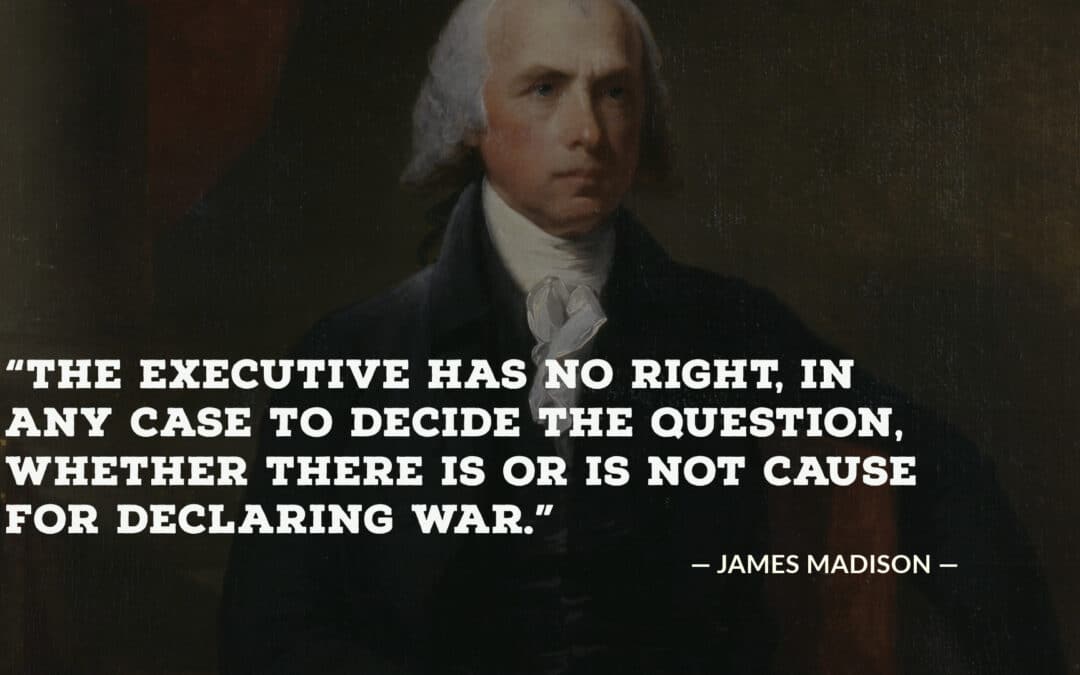
“The power to declare war, including the power of judging the causes of war, is fully and exclusively vested in the legislature”
- James Madison

The founders were absolutely clear in their demand that the country would only go to war upon the collective decision of the representatives of the People. Additionally, a primary reason for creating a system of representation was due to exigencies of the day that made it impossible for the People to meet and decide their fate in person. Thus, the true reason for entrusting the Legislature with the power to declare war was to ensure that the People would be involved in the decision as much as was physically possible.

What the Framers did not imagine was a weak and ineffectual Congress that failed to claim its rightful authority in deciding when the nation would go to war, or a power-hungry President that wouldn’t refuse an extra-constitutional transfer of such power from Congress.

The typical statist response to this argument is to claim that previous Presidents have sent troops into battle “hundreds of times” without a Congressional declaration of war. Thus, the favorite Presidential excuse for claiming the right to initiate war unilaterally is nothing more than the reasoning of a child: Everybody does it.

But, the Constitution remains valid even after Presidents violate it.

We must hold that thought; a transfer of power is a violation of the Constitution by both the President, who accepts the transfer, as well as those in Congress who vote to delegate their Constitutionally-mandated responsibility to another branch. In recent decades, such transfers have ultimately been no more than a blank check for the President.

It has been known throughout history that kings, dictators, and the executive branch of governments are always overly eager to go to war. This is precisely why our founders tried desperately to keep decisions about going to war in the hands of the Legislature, and close to the People. Unfortunately this process has failed us for decades.

Therefore, one obvious reason for dividing the war powers was to prevent such dictatorial powers from being placed in the hands of one person, the President. The framers understood that, throughout history, rulers of nations worldwide had begun wars strictly on the basis of international politics or personal desires.

They clearly understood that rulers would often get the urge to remove foreign public officials, or dictate the policies of foreign nations, and that such urges are dangerous to liberty, no matter what the reason. Sometimes they would do this by sending money to opposing groups with taxpayer money, and sometimes they would do so by assassination or coup.

But, history has proven to us that when all else fails, such despotic leaders will ultimately resort to invasion; as President Bush and his son did with Iraq; as Presidents Kennedy and Johnson did with Vietnam; as President Clinton did with Yugoslavia; as President Truman did with Korea; and as other Presidents did with less fanfare but similar vigor.

Another reason for entrusting the Congress with the power to declare war was in the hope that this would ensure, as much as possible, that a war was justified. Thus, the idea was that if a President desired to send the nation into war, an appeal to the People, through their representatives, would be required to convince them of the justification for war. Although our experience has shown that they failed, the framers desperately tried to minimize the potential for political entanglements in foreign affairs by dividing the war powers between the President and the Congress.

Why was all this so important to the framers? Because they wisely feared dictatorial powers; even in the hands of an elected leader. They also recognized that, of all potential enemies to liberty, war is the worst because it provides the greatest opportunity for the government to infringe on our rights! As James Madison suggested:

“Of all the enemies to public liberty war is, perhaps, the most to be dreaded, because it comprises and develops the germ of every other. War is the parent of armies; from these proceed debts and taxes; and armies, and debts, and taxes are the known instruments for bringing the many under the domination of the few.”

We must now recognize that the millions of dead in Korea and Vietnam, as well as the current quagmires in Iraq and Afghanistan, all result from the same defective policy of ignoring our laws as codified in the Constitution; all result from the same faulty foreign policy of American interventionism that our government has pursued for more than a century. It would be overly simplistic, and completely erroneous, to say that the current administration is alone responsible for such actions and our current wars. This is an endemic problem in our system of governance that crosses party lines, and has infected nearly every person who is involved in the administration of our government’s foreign policy.

By rejecting the advice and the rules laid down by the founders and early Presidents, our recent leaders have gone so far astray from warnings against entangling alliances, that the founders would hardly recognize the government they created. Policing the world and “spreading democracy” is not our calling. Additionally, no such action is permitted by the Constitution.

These concepts are the key to solving our problems. If we don’t want our delegated rulers to violate the contract they have sworn to uphold; if we don’t want blank checks drawn indefinitely on the public liberty and on civil society, we must strive to have our politicians follow the law that governs the government – the Constitution.

“Allow the President to invade a neighboring nation, whenever he shall deem it necessary to repel an invasion, and you allow him to do so, whenever he may choose to say he deems it necessary for such purpose; and you allow him to make war at pleasure. Study to see if you can fix any limit to his power in this respect, after you have given him so much as you propose. If, today, he should choose to say he thinks it necessary to invade Canada, to prevent the British from invading us, how could you stop him? You may say to him, ‘I see no probability of the British invading us’ but he will say to you, ‘be silent; I see it, if you don’t.’”
- Abraham Lincoln

Comments (10)


Follow...


Sponsored Links


Sponsored Links


Tenth Amendment Pledge


Sponsored Links


Categories


Archives