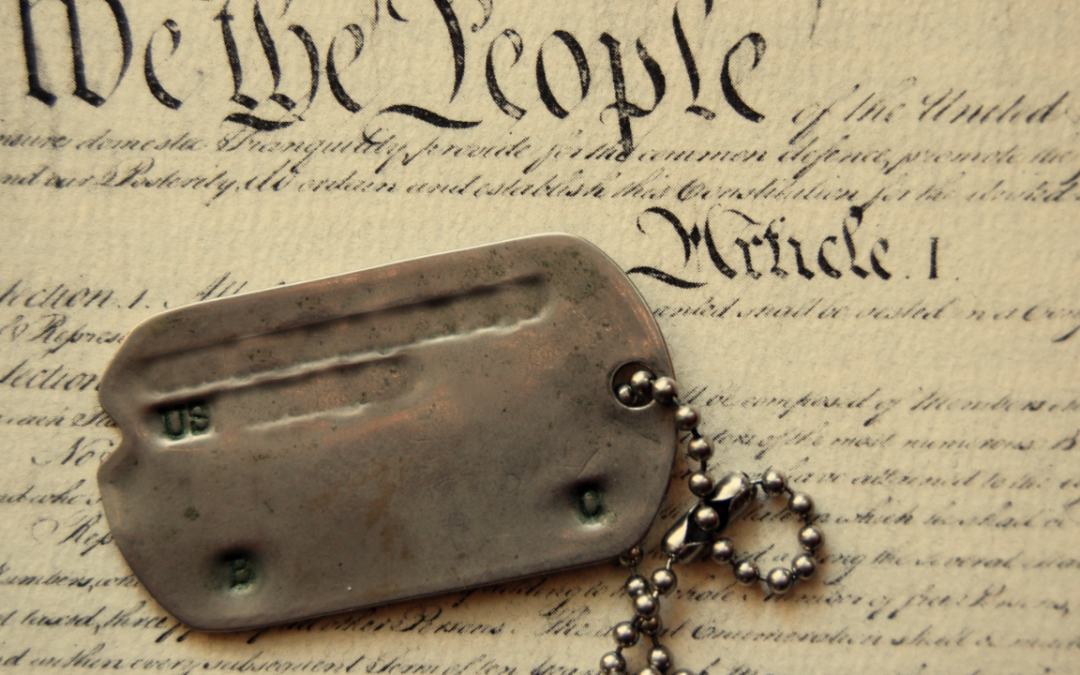
A recent OpEd by Mario Cuomo in the Los Angeles Times, What The Constitution Says About Iraq, gave some surprisingly good analysis of how the Iraq war is a direct violation of the constitution. Here’s a few tidbits: Continue Reading
Posted on 04 September 2007 by Tenth Amendment
A recent OpEd by Mario Cuomo in the Los Angeles Times, What The Constitution Says About Iraq, gave some surprisingly good analysis of how the Iraq war is a direct violation of the constitution. Here’s a few tidbits: Continue Reading
Posted on 01 September 2007 by Tenth Amendment
Reports from the UK are talking about a British General lambasting US policy failures in Iraq. From the Guardian:
The bitter transatlantic row over Iraq intensified as another key British general lambasted the US for bungling the aftermath of the invasion.
Major General Tim Cross, the most senior UK officer involved in the post-war planning, said Washington’s policy had been “fatally flawed”. He also insisted he had raised serious concerns about the possibility of the country sliding into chaos with Donald Rumsfeld - but the then-US defence secretary “dismissed” the warnings.
Once again, the personalities and the media are concerned with the symptoms of our problems in Iraq - rather than the cause. Continue Reading
Posted on 01 July 2007 by Tenth Amendment
The framers of the Constitution attempted to balance the power of the President as commander-in-chief with that of Congress, the representatives of the People. Article II, Section 2 of the Constitution gives to the Executive Branch the command of the nation’s armed forces, while Article I, Section 8 gives to the Legislative Branch the power to decide when the United States goes to war. They weighed the individual will of the Executive against the deliberative function of the Legislature, whose constituents would bear the full costs of any war.
Thus, the framers deliberately separated the powers of declaring and waging war; they confined these powers in such a way so as to thwart the tyranny of kings. Despite being known as one of the greatest champions of centralized power of the times, even Alexander Hamilton felt that the President must generally bow to Congressional directions in times of peace and also in times of war. He stated this clearly in Federalist #69:
“The President is to be commander-in-chief of the army and navy of the United States. In this respect, his authority would be nominally the same with that of the king of Great Britain, but in substance much inferior to it. It would amount to nothing more than the supreme command and direction of the military and naval forces.; while that of the British king extends to the declaring of war and to the raising and regulating of fleets and armies - all which, by the Constitution under consideration, would appertain to the legislature.”
Our nation’s founders were far from perfect, and at times, inconsistent and unjust; but, on the powers of war, they were unwavering, and their principles were sound. Therefore, we must also consider the following statements:
“The separation of the power of declaring war from that of conducting it, is wisely contrived to exclude the danger of its being declared for the sake of its being conducted.”
- James Madison
“This system will not hurry us into war; it is calculated to guard against it. It will not be in the power of a single man, or a single body of men, to involve us in such distress; for the important power of declaring war is vested in the legislature at large: this declaration must be made with the concurrence of the House of Representatives: from this circumstance we may draw a certain conclusion that nothing but our interest can draw us into war.”
- James Wilson
“Considering that Congress alone is constitutionally invested with the power of changing our condition from peace to war, I have thought it my duty to await their authority for using force in any degree which could be avoided.”
- Thomas Jefferson
“The power to declare war, including the power of judging the causes of war, is fully and exclusively vested in the legislature”
- James Madison
The founders were absolutely clear in their demand that the country would only go to war upon the collective decision of the representatives of the People. Additionally, a primary reason for creating a system of representation was due to exigencies of the day that made it impossible for the People to meet and decide their fate in person. Thus, the true reason for entrusting the Legislature with the power to declare war was to ensure that the People would be involved in the decision as much as was physically possible.
What the Framers did not imagine was a weak and ineffectual Congress that failed to claim its rightful authority in deciding when the nation would go to war, or a power-hungry President that wouldn’t refuse an extra-constitutional transfer of such power from Congress.
The typical statist response to this argument is to claim that previous Presidents have sent troops into battle “hundreds of times” without a Congressional declaration of war. Thus, the favorite Presidential excuse for claiming the right to initiate war unilaterally is nothing more than the reasoning of a child: Everybody does it.
But, the Constitution remains valid even after Presidents violate it.
We must hold that thought; a transfer of power is a violation of the Constitution by both the President, who accepts the transfer, as well as those in Congress who vote to delegate their Constitutionally-mandated responsibility to another branch. In recent decades, such transfers have ultimately been no more than a blank check for the President.
It has been known throughout history that kings, dictators, and the executive branch of governments are always overly eager to go to war. This is precisely why our founders tried desperately to keep decisions about going to war in the hands of the Legislature, and close to the People. Unfortunately this process has failed us for decades.
Therefore, one obvious reason for dividing the war powers was to prevent such dictatorial powers from being placed in the hands of one person, the President. The framers understood that, throughout history, rulers of nations worldwide had begun wars strictly on the basis of international politics or personal desires.
They clearly understood that rulers would often get the urge to remove foreign public officials, or dictate the policies of foreign nations, and that such urges are dangerous to liberty, no matter what the reason. Sometimes they would do this by sending money to opposing groups with taxpayer money, and sometimes they would do so by assassination or coup.
But, history has proven to us that when all else fails, such despotic leaders will ultimately resort to invasion; as President Bush and his son did with Iraq; as Presidents Kennedy and Johnson did with Vietnam; as President Clinton did with Yugoslavia; as President Truman did with Korea; and as other Presidents did with less fanfare but similar vigor.
Another reason for entrusting the Congress with the power to declare war was in the hope that this would ensure, as much as possible, that a war was justified. Thus, the idea was that if a President desired to send the nation into war, an appeal to the People, through their representatives, would be required to convince them of the justification for war. Although our experience has shown that they failed, the framers desperately tried to minimize the potential for political entanglements in foreign affairs by dividing the war powers between the President and the Congress.
Why was all this so important to the framers? Because they wisely feared dictatorial powers; even in the hands of an elected leader. They also recognized that, of all potential enemies to liberty, war is the worst because it provides the greatest opportunity for the government to infringe on our rights! As James Madison suggested:
“Of all the enemies to public liberty war is, perhaps, the most to be dreaded, because it comprises and develops the germ of every other. War is the parent of armies; from these proceed debts and taxes; and armies, and debts, and taxes are the known instruments for bringing the many under the domination of the few.”
We must now recognize that the millions of dead in Korea and Vietnam, as well as the current quagmires in Iraq and Afghanistan, all result from the same defective policy of ignoring our laws as codified in the Constitution; all result from the same faulty foreign policy of American interventionism that our government has pursued for more than a century. It would be overly simplistic, and completely erroneous, to say that the current administration is alone responsible for such actions and our current wars. This is an endemic problem in our system of governance that crosses party lines, and has infected nearly every person who is involved in the administration of our government’s foreign policy.
By rejecting the advice and the rules laid down by the founders and early Presidents, our recent leaders have gone so far astray from warnings against entangling alliances, that the founders would hardly recognize the government they created. Policing the world and “spreading democracy” is not our calling. Additionally, no such action is permitted by the Constitution.
These concepts are the key to solving our problems. If we don’t want our delegated rulers to violate the contract they have sworn to uphold; if we don’t want blank checks drawn indefinitely on the public liberty and on civil society, we must strive to have our politicians follow the law that governs the government – the Constitution.
“Allow the President to invade a neighboring nation, whenever he shall deem it necessary to repel an invasion, and you allow him to do so, whenever he may choose to say he deems it necessary for such purpose; and you allow him to make war at pleasure. Study to see if you can fix any limit to his power in this respect, after you have given him so much as you propose. If, today, he should choose to say he thinks it necessary to invade Canada, to prevent the British from invading us, how could you stop him? You may say to him, ‘I see no probability of the British invading us’ but he will say to you, ‘be silent; I see it, if you don’t.’”
- Abraham Lincoln
Posted on 21 May 2007 by Tenth Amendment
“Not all the treasures of the world, so far as I believe, could have induced me to support an offensive war, for I think it murder.” — Thomas Paine
One of the many consequences of our current political climate, in which war seems to be almost endless, is that people are often driven to ask fundamental questions about the powers of war.
We must keep in mind that the Constitution was written under what’s referred to as “positive grant.” In short, this means that the only powers that the federal government can exercise are those specifically listed in the Constitution. Many of the founders were so concerned about this issue that they wrote the Tenth Amendment to put the concept of positive grant into writing.
“The powers not delegated to the United States, by the Constitution, nor prohibited to it by the States, are reserved to the States, respectively, or to the People.”
It is here clearly stated that the United States Constitution rests on a strict enumeration of federal powers; if a power was not specifically given by the People, the federal government simply cannot do it.
Ever since the Korean War, Article II, Section 2 of the Constitution has been regularly cited as justification for the President to act with a seemingly free reign in the realm of foreign policy - including the initiation of foreign wars. But, it is Article I, Section 8 of the Constitution that lists the power to declare war, and this power is placed solely in the hands of Congress.
Article II, Section 2, on the other hand, refers to the President as the “commander-in-chief of the army and navy of the United States.” What the founders meant by this clause was that once war was declared, it would then be the responsibility of the President, as the commander-in-chief, to direct the war.
Alexander Hamilton supported this when he said that the President, while lacking the power to declare war, would have “the direction of war when authorized.” Thus, under the Constitution, the President, acting without a Congressional declaration of war, is authorized only to repel invasion and sudden attacks.
Pre-emptive strikes and undeclared offensive military expeditions are not mentioned in the Constitution, and are, therefore, unlawful. Thomas Jefferson stated this quite eloquently when, in 1801, he said that, as President, he was “unauthorized by the Constitution, without the sanction of Congress, to go beyond the line of defense.”
In Federalist #69, Alexander Hamilton explained that the President’s authority:
“would be nominally the same with that of the King of Great Britain, but in substance much inferior to it. It would amount to nothing more than the supreme command and direction of the military and naval forces, as first general and admiral of the confederacy; while that of the British king extends to the declaring of war, and to the raising and regulating of fleets and armies; all which by the constitution under consideration would appertain to the legislature.”
James Madison warned us that the power of declaring war must be kept away from the executive branch when he wrote to Thomas Jefferson:
“The constitution supposes, what the history of all governments demonstrates, that the executive is the branch of power most interested in war, and most prone to it. It has accordingly with studied care vested the question of war in the legislature.”
TRANSFER OF POWER
For the last sixty-plus years, our nation has been involved in numerous conflicts and wars. Since World War II, our military has sustained nearly 100,000 deaths and over a quarter million wounded.
For over six decades, millions and millions of Americans have been dragged into battle, without a declaration of war from the representatives of the People, and with essentially no clear victories.
What has this led to? In matters of peace and war, Presidential rule has completely replaced the rule of law in the United States.
The Congress has relinquished its Constitutionally-mandated responsibility to declare war over and over, and, every time, the President has not done his duty in this situation, either. When one branch of government is in violation of the Constitution, it’s the role of one or both of the other branches to “check” it.
Thus, when the Congress illegally transfers the power to declare war to the President, it is the President’s duty to refuse that transfer of power. The president’s job would be to explain to the American people what was done, why it was unconstitutional, and demand that Congress live up to its oath. Unfortunately, the last 60+ years has not produced a single president who has refused such an unconstitutional transfer of power.
PERPETUAL WARFARE
The last time Congress declared war was on December 11, 1941; against Germany, in response to its formal declaration of war against the United States. This resolution was quickly accomplished with a statement that was well-under one page in length; yet it still clearly delineated who the enemy was, and what was to be done. Three days previously, and one day after being attacked at Pearl Harbor, Congress declared war on Japan with a similar clarity. Both actions resulted in a clear-cut military victory.
But, since then, things have been quite different.
President Truman gave us the Korean War without Congressional Declaration, and Presidents Kennedy, Johnson, and Nixon did the same in Vietnam. President Bush brought us an undeclared war in Iraq in 1991, which President Clinton continued with sanctions and bombing raids throughout his two terms.
In 1999, he also engaged us in a war with Yugoslavia without a declaration from Congress. In September 2001, Congress transferred to President Bush the power to fight whomever he determined aided the September 11th attacks, or harbored the culprits; its resolution did not even mention Afghanistan, although war has been waged by our military in that country ever since. And, in October 2002, Congress let Mr. Bush alone decide whether or not to attack Iraq; and, as we know he responded with a full-scale invasion.
Powerful people continually tell us that if Truman, Johnson, Clinton, et al, could initiate war without a Congressional declaration, then any current or future President could do likewise. Precedent now supposedly trumps the rule of law. But, the Constitution remains valid even after presidents violate it.
NOT JUST THE LAW, A GOOD IDEA TOO
There are many reasons why following the Constitution is not only within the law, but a good idea too.
The first goal of having Congress declare war was to ensure that the representatives of the states and the people would be the ones discussing matters of peace and war. This would, theoretically, create a greater climate of responsibility, and it seems that it may have done so to some degree. Since this constitutional clause has been ignored, the number and length of American wars has increased while the “success” rate has drastically decreased.
A Congressional declaration of war limits Presidential powers, narrows the focus of the action, and implies, or clearly stipulates a precise end-point to the conflict. When left in the hands of just one person, we can be assured that there is only one opinion on war. Conversely, the more people there are involved in making that decision, the greater the chance that the country will not get involved in costly, deadly and worthless wars.
Thus, as with so many other issues in government, the proper direction for the future is to demand that elected politicians uphold their oath and follow the Constitution.