Archive | History

Tags: , , ,

Traitors to the American Revolution

Posted on 04 November 2009 by Tenth Amendment

by Thomas J. DiLorenzo, LewRockwell.com

The American Revolution was waged against a highly centralized, nationalistic governmental tyranny run by a king, namely, the British Empire. The king enriched himself and his regime through the economic institution of mercantilism, defined by Murray Rothbard as “a system of statism which employed economic fallacy to build up a structure of imperial state power, as well as special subsidy and monopolistic privilege to individuals or groups favored by the state.” This system impoverished the average Englishman but was a perpetual source of power and riches for the king and his political allies. That is why the system lasted so long (at least two centuries) despite the fact that it was so harmful to the average citizen.

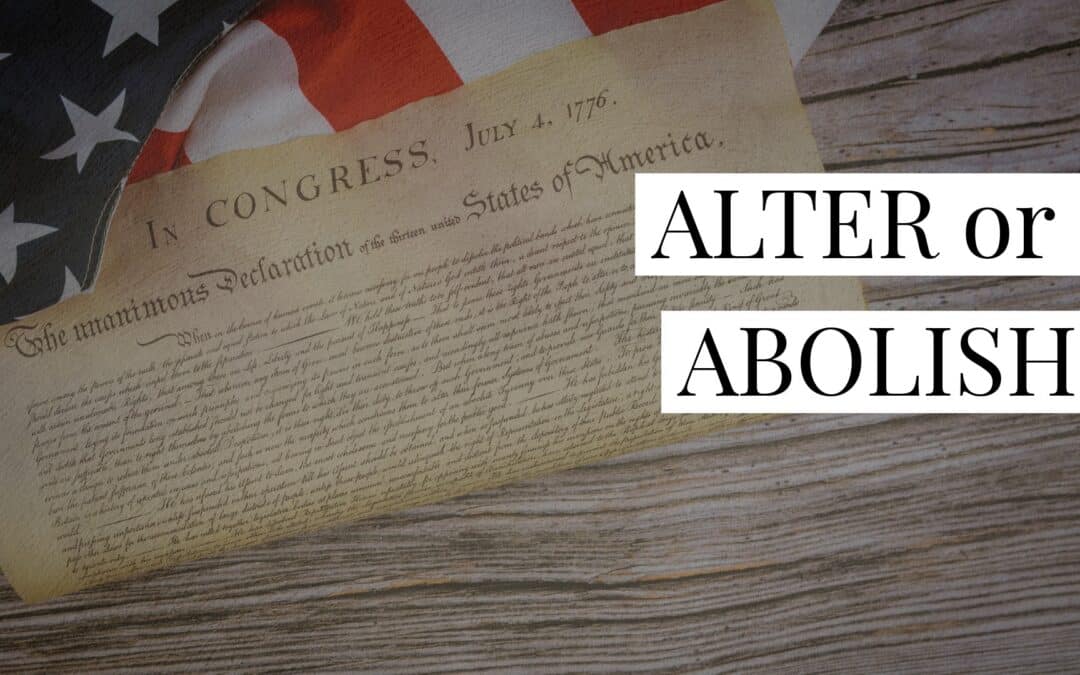
After the Seven Years War with France the king of England needed to pay off his war debts, so he stepped up the application of the corrupt mercantilist system to the American colonists. He did so with numerous taxes and interferences with international trade that benefited British businesses and the British state while treating the colonists like tax serfs. The “train of abuses” delineated in the Declaration of Independence were mostly abuses of the colonists for the purpose of plundering them with the British mercantilist system. Continue Reading

Comments (9)

Tags: , ,

States’ Rights: The Unknown History

Posted on 23 October 2009 by Tenth Amendment

Continue Reading

Comments (4)

Tags: , ,

Slaves to a Federal Tyranny

Posted on 04 October 2009 by Tenth Amendment

by Thomas J. DiLorenzo, LewRockwell.com

The federal government today can wage wars without the consent of our congressional representatives, overthrow foreign governments, tax nearly half of national income, abolish civil liberty in the name of “homeland security” and “the war on drugs,” legalize and endorse infanticide (”partial-birth abortion”), regulate nearly every aspect of our existence, and there’s little or nothing we can do about it. “Write your congressman” is the refrain of the slave to the state who doesn’t even realize he’s a slave (thanks to decades of government school brainwashing).

But Americans were not always slaves to federal tyranny. Perhaps the best illustration of this is how Americans once utilized the Jeffersonian, states’ rights traditions of nullification and interposition to assist President Andrew Jackson in his campaign to veto the re-chartering of the Second Bank of the United States (BUS) in 1832. Jackson essentially ended central banking in America until it was revived thirty years later by the Lincoln administration. The story is told in James J. Kilpatrick’s wonderful 1957 book, The Sovereign States: Notes of a Citizen of Virginia.

The Bank was notorious for fraud, mismanagement, corruption, and attempts to engineer a “political business cycle.” Prior to 1861, the American people were still sovereign over their government. They exercised that sovereignty in the way the founders intended: through state political conventions or legislatures. The federal government was their agent.

Consequently, as early as 1816, Indiana and Illinois amended their state constitutions to prohibit the BUS from establishing branches within their jurisdictions. North Carolina, Georgia, and Maryland imposed heavy taxes on BUS branches within their states in attempts to tax them out of existence (A tax that even libertarians could love!). Knowing that such taxes could destroy the central bank, the federal government brought suit in Maryland (McCulloch vs. Maryland), confident that John Marshall, chief justice of the Supreme Court and a proponent of the BUS, would rule in its favor. He did, coining the famous phrase that “the power to tax involves the power to destroy” in his decision. He wasn’t expressing a fear that taxation could destroy private initiative and private enterprise, but that it could limit the federal government’s monetary monopoly.

Despite Marshall’s opinion that state taxes on the BUS were unconstitutional, numerous states continued to harass the bank. Until 1865, the Supreme Court’s opinion was just the Supreme Court’s opinion. The citizens of the states reserved the right to offer their own opinions on constitutionality, which they often considered to be every bit as valid as the Court’s. The same was true of certain presidents: Andrew Jackson essentially said “thank you for your opinion” and then thumbed his nose at the Court when it ruled that the BUS was constitutional.

After Marshall’s 1819 opinion, Ohio enacted a $50,000 per year tax on the BUS. The Bank refused to pay, so the Ohio state auditor ordered a deputy, one John L. Harper, to collect the tax. As Kilpatrick (p. 151) explains it:

[O]n the morning of September 17, Harper made one last request for voluntary payment. When this was denied, he leaped over the counter, strode into the bank vaults, and helped himself to $100,000 in paper and specie. He then turned this over to a deputy . . . stuffing this considerable hoard into a small trunk, with which the party thoughtfully had come equipped . . .

This would be the equivalent of today’s governor of Ohio ordering state troopers to enter the Cleveland Fed and strip its vaults of over a million dollars. The BUS sued Ohio, relying on Marshall’s opinion. The Ohio legislature considered such a lawsuit to be a threat to citizen sovereignty and a dangerous precedent to all Americans, not just Ohioans. It issued a statement saying, “To acquiesce in such an encroachment upon the privileges and authority of the States, without an effort to defend them, would be an act of treachery to the State itself, and to all the States that compose the American Union (emphasis added).”

The legislature stated that it was aware of the theory that the Supreme Court is to be the interpreter of the Constitution, but declared that “to this doctrine . . . they can never give their assent” (Kilpatrick, p. 152). The legislature quoted Jefferson’s Kentucky Resolve of 1798, which said that “as in all other cases of compact among parties having no common judge,” each party “has an equal right to interpret the Constitution for themselves, where their sovereign rights are involved . . .”

Marshall was wrong, the Ohioans said, because his opinion unconstitutionally encroached upon the sovereignty of the states. Therefore, they were under no obligation to acquiesce in his ruling.

The Ohio legislature promised to return the $100,000 if the BUS left the state. If not, it proposed a law forbidding “the keepers of our jails” from imprisoning any person “committed at the suit of the Bank of the United States”; prohibiting Ohio courts from “taking acknowledgements of conveyance where the Bank is a party”; and forbidding “our courts, justices of peace, judges and grand juries from taking any cognizance of any wrong alleged to have been committed upon any species of property owned by the Bank.” Invoking Jefferson’s “Doctrine of ’98,” the Ohioans concluded by “denouncing the Federal courts for violation of the Constitution” (p. 154).

The BUS persisted in its lawsuit, and eventually had the state treasurer arrested and imprisoned. While in prison, the keys to the state vaults were physically taken from him and the feds took back the $100,000, apparently still in the same trunk.

This act infuriated the Ohioans even more, and they continued to harass the Bank, as did many other states. Kentucky and Connecticut adopted Ohio’s states’ rights stand toward the Bank in 1825. In 1829, South Carolina imposed a tax on stockholders of the Bank within the state. New York and New Hampshire enacted resolutions urging that the Bank not be re-chartered. As Kilpatrick concludes:

In the face of this unrelenting warfare, the bank could not survive. Withdrawal of the public deposits began in August of 1833, under Jackson’s order; and when Pennsylvania governor Wolf, who had been one of the bank’s staunchest supporters, denounced the institution in . . . March of 1834, public opinion was fatally influenced against the bank. The Pennsylvania Senate adopted fresh resolutions urging that the bank ought not to be re-chartered. The following month, the United States House of Representatives adopted the same view, and the bank’s days came to an end (p. 157).

Andrew Jackson is usually given credit for (temporarily) ending central banking in America in the nineteenth century. But he had help. It was this expression of citizen sovereignty, in the spirit of the Jeffersonian states’ rights tradition, that made Jackson’s veto of the bank politically possible.

States’ rights as a check on the tyrannical proclivities of the central government ended in 1865, of course. As Forrest McDonald noted in States’ Rights and the Union (p. 224), after Lincoln’s war the Supreme Court “became the sole and final arbiter of constitutional controversies. No longer could a Jefferson arise to insist that the other branches of the federal government had coequal authority to determine constitutionality. No more could a Calhoun arise to defend a doctrine of interposition or nullification.”

The imperious Woodrow Wilson would celebrate this fact in his 1908 book, Constitutional Government in the United States, where he wrote (p. 178) that “the War between the States established . . . this principle, that the federal government is, through its courts, the final judge of its own powers.”

In A View of the Constitution, published a century earlier, the Jeffersonian legal scholar St. George Tucker cited this phenomenon as the very definition of tyranny. If the federal government ever became the final judge of the limits of its own powers, Tucker warned, then constitutional liberty would become an empty phrase. The federal government would inevitably conclude that there are, in fact, no limits to its power.

Thomas J. DiLorenzo is professor of economics at Loyola College in Maryland and the author of The Real Lincoln; Lincoln Unmasked: What You’re Not Supposed To Know about Dishonest Abe and How Capitalism Saved America. His latest book is Hamilton’s Curse: How Jefferson’s Archenemy Betrayed the American Revolution – And What It Means for America Today.

Note: This article was originally published on May 9, 2003

Copyright © 2003 LewRockwell.com  Permission to reprint in whole or in part is gladly granted, provided full credit is given.

Comments (9)

Tags: ,

The People Who Lost?

Posted on 16 September 2009 by Tenth Amendment

by Walt Garlington

“The people who lost”: Bill Kauffman uses this quote from historian William Appleman Williams to begin his book, Forgotten Founder Drunken Prophet, on the Anti-Federalists – those who opposed the ratification of the current U. S. Constitution during and after the Constitutional Convention of 1787.

Most of the state delegations at Philadelphia were populated by Federalists –men dedicated chiefly to strengthening the power of the federal government. To this class belonged the famous men of our history: e. g., Alexander Hamilton, George Washington, Gouverneur Morris, James Madison (a surprise to me to find him in this camp). Continue Reading

Comments (13)

Tags: , ,

The Marbury v. Madison Mantra

Posted on 10 September 2009 by Tenth Amendment

by Timothy Baldwin, Esq.

From Chuck Baldwin: Note: My son, Tim, writes today’s column. He is an attorney who received his Juris Doctor degree from Cumberland School of Law in Birmingham, Alabama. He is a former prosecutor for the Florida State Attorney’s Office and now owns his own private law practice. He is author of a new book, published soon by Agrapha Publishing, entitled FREEDOM FOR A CHANGE

The arguments against the power of the states to arrest federal tyranny are as predictable as the sun coming up in the morning, and they are as philosophical in nature as the Declaration of Independence. One of the most commonly used arguments against such a State power is the United States Supreme Court (US S CT) dicta opinion in Marbury v. Madison in 1803, written by Chief Justice John Marshall. Before getting into the misunderstandings and misapplications of that infamous decision, we must first recognize the source and character of Marshall’s opinion. As Marshall himself admitted that the US is to be a country of “laws, not men,” we must establish that Marshall’s opinion does not equate to the “supreme law of the land” which the states and individuals are bound to obey. If our submission only requires that the US S CT speak, then we do not live as freemen, but as slaves. Continue Reading

Comments (15)

Tags: , ,

Thomas E. Woods: Our States’ Rights Tradition

Posted on 10 September 2009 by Tenth Amendment

Audio clip: Adobe Flash Player (version 9 or above) is required to play this audio clip. Download the latest version here. You also need to have JavaScript enabled in your browser.

Tom Woods appeared as a guest on Antiwar Radio to discuss his article, The States’ Rights Tradition Nobody Knows, which was recently featured here at TenthAmendmentCenter.com.

He discusses the debt some progressive causes owe to states’ rights, the Kentucky and Virginia Resolutions, state nullification of unconstitutional federal laws, the undue respect given to the Supremacy Clause, and more.

Thomas E. Woods is the New York Times bestselling author of nine books, including Meltdown: A Free-Market Look at Why the Stock Market Collapsed, the Economy Tanked, and Government Bailouts Will Make Things Worse.  A senior fellow at the Ludwig von Mises Institute, Woods holds a bachelor’s degree in history from Harvard and his master’s, M.Phil., and Ph.D. from Columbia University.

Comments (7)

Tags: , ,

Decentralization for Socialists: A Brief Primer

Posted on 25 August 2009 by Tenth Amendment

by Brion McClanahan, LewRockwell.com

One thing that consistently vexes me is the amount of time the modern statists, particularly on the Left, spend labeling the idea of decentralization and secession as “kooky.” The Virginia and Kentucky Resolutions of 1798 – if they have read them or know about them – are often portrayed as quaint and unsophisticated pronouncements of provincialism; the Essex Junto and Hartford Convention are called the products of deranged Northern madmen; Andrew Jackson, they say, was on the right side when he threatened the use of force to keep South Carolinian secessionists in line in 1832; and of course, they revel in the ultimate coup de grâce to states’ rights and secession, the Northern victory in the War for Southern Independence. Who could root for the evil, “undemocratic slave power” clad in butternut, anyway?

This would be well and good if their arguments were logical. They of course forget that the South seceded through a democratic process, but beyond that, one only has to look at the history of American socialists and reformers to find that many of them were secessionists and viewed decentralization as the logical path to their “utopian” society. Continue Reading

Comments (12)

Tags: , ,

Temporary Taxes Are Rarely Temporary

Posted on 20 August 2009 by Tenth Amendment

by State Sen. Mike Folmer (PA-48)

Tem·po·rar·y – an adjective meaning lasting, used, serving, or enjoyed for a limited time. Derived from the Latin tempora rius, from tempus, tempor-, time.  Synonyms include temporary, acting, ad interim, interim, provisional. Antonym is permanent.

Governor Rendell continues to press for a temporary, 16 percent increase in the Personal Income Tax (PIT), which he argues is the state’s “best option” to balance the state budget. Continue Reading

Comments (5)

Tags: , , , ,

The States Rights Tradition No One Knows

Posted on 14 August 2009 by Tenth Amendment

by Thomas E. Woods

Jefferson once wrote, “When all government, domestic and foreign, in little as in great things, shall be drawn to Washington as the center of all power, it will render powerless the checks provided of one government on another, and will become as venal and oppressive as the government from which we separated.” To resist this centralizing trend, the sage of Monticello was convinced, the states needed some kind of corporate defense mechanism.

CLICK HERE TO READ THE FULL ARTICLE

Comments (0)

Tags: , , ,

Line in the Stand: The State Sovereignty Movement

Posted on 11 August 2009 by Tenth Amendment

by Timothy Baldwin, Esq.

From Chuck Baldwin: My son, Tim, writes today’s column. He is an attorney who received his Juris Doctor degree from Cumberland School of Law in Birmingham, Alabama. He is a former prosecutor for the Florida State Attorney’s Office and now owns his own private law practice. He is married to the former Miss Jennifer Hanssen.

On July 10, 2009, Alaska Governor Sarah Palin became the second governor in these States United (Governor Phil Bredesen of Tennessee is the other one) to sign into effect a State Sovereignty Resolution. These Sovereignty-type bills, resolutions and laws are an obvious and rightful response that the super-majority of the States in the Union are expressing to and against the usurping powers of the federal government. While the effects of federal tyranny are being felt more seriously than ever, history and human nature prove that the people of a society do not respond or revolt immediately against tyranny–though they have a right to. America’s resistance is no different. Fortunately, the sleeping giant is being awakened, to the dismay of our Centralist-worshipers today.

An observer of history and these current events cannot help but draw strikingly similar comparisons to America’s political struggles during the early to mid-1800s, where there was a serious threat to our original form of constitutional government by the Centralists of that day. During the presidency of John Adams, the people of the States realized and rejected the pro-centralist view of Adams and his ilk (e.g., Alexander Hamilton), and a battle between the ideology of centralism and federalism thrust itself into the forefront of political concern. Continue Reading

Comments (30)


Follow...


Sponsored Links


Sponsored Links


Tenth Amendment Pledge


Sponsored Links


Categories


Archives