Archive | Founding Principles

Tags: , ,

The Missing Patent and the Health Care Debate

Posted on 01 November 2009 by Tenth Amendment

by Paul Ballonoff

The interest of the current administration in creating a federal national health care program, has provoked discussion of whether the federal government has sufficient power to do so. Often, the discussion is phrased as whether “the government” has sufficient power. Others have asked if the federal government has the power to compel individuals to purchase health insurance.

My article (“Limits to Regulation due to the Interaction of the Patent and Commerce Clause”, in CATO Journal, Vol. 20, No. 3, Winter 2001, pages 401 – 423), gives an insight into both questions, by answering this one: why does the so-called “patent clause” of the federal constitution, not use the word “patent”?

If the word “patent” meant what we currently mean by that term, then the clause could have simply stated the relevant power by saying the federal government can issue patents. Instead, the “patent clause” carefully states that the Congress has the power to issue exclusive rights for a limited time to authors or inventors. It does not use the word “patent” at all.

As reviewed in that article, this use of words tells us a great deal about the purposes and structure of the federal constitution. Citing principal legal scholars of the day, the article shows that at the time the federal constitution was written, the word “patent” actually had a much broader meaning. It referred to any government grant of an economic right, called in the article a “general patent power”. Of course if the federal government can grant such rights without limit, we would not need to ask if the federal government has such power over health care.

Yet we ask. On the other hand, when the US states have created health care programs, or otherwise regulated matters like health insurance, the existence of that power in a state has been little questioned. And note: this common understanding is consistent with the 10th Amendment to the federal constitution, that powers not enumerated to the federal Congress are reserved to the states respectively or to the people.

So looking carefully at the choice of words in the “patent clause” tells us a great deal on what the federal government cannot do. The only general patent power granted by the federal constitution to the federal Congress is the specifically described power to create what we today call patents. All other aspects of the general patent power were not given to the federal government, so if exercised at all could be done only by states.

For example, the states can, and normally do, protect the general welfare by requiring holders of driver licenses (issue of which is a proper exercise of a general patent power by a state government) to also buy accident insurance. The federal government however does not regulate drivers or issue of driver licenses within the jurisdiction of any state.

Given this careful allocation of general patent powers, principally to the states, what then is the role if any of the federal government in matters of commerce? Since the word “patent” when the federal constitution was written refers to allocation of economic rights, and those powers generally were reserved to states (or the people), then the commerce language of the federal constitution cannot be interpreted as a general allocation of such power to the federal government. Had that been the intent, the simple grant to Congress of a power to issue patents, without any other words, would have been sufficient.

Now, the federal commerce clause (Article I, Section 8 of the federal constitution) says that Congress has the power: “to regulate commerce with foreign nations, and among the several States, and with the Indian tribes.” But we just saw that Congress has no power to regulate commerce among the several States by the use of an exclusive federal grant of markets, or indeed to allocate those markets, because to do so in that form would be to exercise a power (the “general patent power”) not granted. Since the Congress has no power to allocate economic rights (except what today we call patents), therefore, the commerce language must have some other meaning.

But that meaning also is not a mystery. A review of other powers of the federal government in relation to states, shows that the role of the federal government is to prevent overly restrictive use of powers by the states. Thus, in commerce among the several states, (“interstate commerce”) the role of the federal government was not to allocate rights, but to prevent the states from unduly closing commerce when they exercise their own powers to allocate rights.

This fact is consistent with the historical problem of the day, when states had often done exactly that, to the detriment of the general welfare of all. The “general welfare” words of the federal constitution in no sense changes this separation of powers. The federal government protects the general welfare by preventing excesses of exercise of power by the states.

The details of those arguments are laid out in the referenced article. The application to the health care debate seems straight forward: the states can require health insurance or not, as each may choose; the states could create state supported systems of health care for their citizens, if they choose. The federal government can do neither.

What the federal government might do is this: if in the exercise of their rights to regulate health insurance or provide it, the states create rules that obstruct commerce in health care, then the Congress can prevent such obstruction. It is not simply ironic that the one thing the Congress might be able to constitutionally do with regard to health care, to remove obstruction to competitive access, is not among those included in the proposed legislation.

Paul A. Ballonoff operates Ballonoff Network in Alexandria, VA.

Copyright © 2009, Paul A. Ballonoff

Comments (20)

Tags: , ,

Freedom’s Destruction through Constitutional Deconstruction

Posted on 24 October 2009 by Tenth Amendment

by Timothy Baldwin

During the Constitutional Convention, from May to September 1787, delegates from the colonies were to gather together for the express purpose of amending the Articles of Confederation to form a “more perfect union” (NOT a completely different union!). The men that met in Philadelphia, Pennsylvania, were under direct and limited orders from their states to attend the Federal Convention explicitly to preserve the federation and State rights and to correct the errors of the existing federal government for the limited purposes of handling foreign affairs, commerce among the states and common defense.

Yet, during that private and secret convention, there were men who proposed that a national system be established in place of their current federal system, destroying State sovereignty in direct contradiction to their orders. (Jonathan Elliot, The Debates in the Several State Conventions on the Adoption of the Federal Constitution as Recommended by the General Convention at Philadelphia in 1787, vol. 1, 2nd ed., [Philadelphia, PA, JB Lippincott, 1891], 121) Of course, the public was not aware of this fact until years after the ratification of the Constitution, when the notes taken in the convention were printed and released to the public. Continue Reading

Comments (14)

Tags: , , ,

They Can’t Push Us Around Forever

Posted on 20 October 2009 by Tenth Amendment

by State Rep. Susan Lynn (TN-57th)

The following is a letter from Tennessee to the other 49 State Legislatures

We send greetings from the Tennessee General Assembly.  On June 23, 2009, House Joint Resolution 108, the State Sovereignty Resolution, was signed by Governor Phil Bredesen.  The Resolution created a committee which has as its charge to:

  • Communicate the resolution to the legislatures of the several states,
  • Assure them that this State continues in the same esteem of their friendship,
  • Call for a joint working group between the states to enumerate the abuses of authority by the federal government, and
  • Seek repeal of the assumption of powers and the imposed mandates.

It is for those purposes that this letter addresses your honorable body. Continue Reading

Comments (137)

Tags: , ,

The Founders’ Antipathy to Militarism

Posted on 13 October 2009 by Tenth Amendment

by Jacob G. Hornberger, Future of Freedom Foundation

obama-bush

The Third Amendment to the U.S. Constitution provides that “no Soldier shall, in time of peace be quartered in any house, without the consent of the Owner, nor in time of war, but in a manner to be prescribed by law.”

Obviously, the Third Amendment has little relevance today. But what is relevant for us today is the mindset that underlay the passage of that amendment – a mindset of deep antipathy toward militarism and standing armies. Our ancestors’ fierce opposition to a powerful military force was consistent with their overall philosophy that guided the formation of the Constitution and the passage of the Bill of Rights. Continue Reading

Comments (14)

Tags: , ,

Jefferson’s Union

Posted on 07 October 2009 by Tenth Amendment

by Luigi Marco Bassani, Mises.org

jeffersonbust

It is astonishing that Jeffersonian scholars have paid so little attention to the states’-rights aspect of Jefferson’s thought. If one reads the Kentucky Resolutions of 1798, Jefferson appears to be the father of the Confederate States of America much more that of the United States. Here, Jefferson sought to provide a constitutional interpretation that would at least in principle prevent the union from “consolidating.” He wanted to keep a system of loose federalism very similar to the one embodied in the Articles of Confederation.

Jefferson took advantage of the first opportunity in which the federalists openly disregarded the Constitution to address problems concerning the relationship between the federal government and the states, and his interpretation placed further limitations to federal power on the grounds that the U.S. were established as a republic based on states’ as well as individual rights.

The occasion was the approval of two acts that posed a serious threat to the system of American liberties. The Alien and Sedition Laws were approved in 1798 (under this law, you could be sent to prison for criticizing the president). The Virginia and Kentucky Resolutions, drawn respectively by Madison and Jefferson, were the opposition answer to those laws.

For the first time in American history, Jefferson outlined the political and juridical doctrine of the “State rights school” that became the standard way of viewing relations between States and Nation in the Southern states during the 19th century, up to the end of the War for Southern Independence.

Revived and perfected by John C. Calhoun, this doctrine became the heart of the controversy between the two sections of the country. Jefferson asserted that the States had created a federal government as a simple agent, subordinate to them, for limited and well-defined functions, and that the federal government did not have any right to expand its own authority.

Each individual State, as far as the controversies regarding the Constitution were concerned, had the right to determine when the compact had been breached, and what measures were most appropriate to restore the violated order and redress the wrong. Thus, it was a right (explicitly called by Jefferson “natural,” therefore sacred) of each State to pronounce the illegitimacy of an act of Congress contrary to the constitutional compact.

Jefferson’s account of the nature of the Union–a voluntary contract among free and independent States in order to establish a common caretaker for few and enumerated things–contains a great deal of common sense. In a nutshell, the idea behind the Resolutions is as follows: the States are the ultimate judges of the constitutionality of federal legislation. This requires a rigorously voluntary framework.

But the Supreme Court, a branch of the federal government, at the time was already becoming what it is now, that is to say the arbiter of conflicts between the States and the federal government. In this case, the constitutional framework is threatened, since the federal government, not the Constitution, becomes the judge of its own expansion. More generally, if the States are expected to obey any federal law, regardless of whether the act had been issued according to the Constitution, only lip service is paid to the system of guarantees known as “federalism.”

Despite the ratification of the federal Constitution, Jefferson believed that vis-à-vis each other, the States remained like individuals in the “state of nature.” To characterize the true nature of the American union, for Jefferson, it was sufficient to transpose the Lockean natural rights model from individuals to the States. He never appealed to the theory of sovereignty (a term that does not even appear in his original draft of the Resolutions) to claim that the States are “free and independent”: their liberty and independence lie in the nature of the bond in which they find themselves, and not in the somewhat metaphysical property of being “original political communities.”

Despite the Constitution, the States retain all of their natural rights with respect to one another–exactly like individuals in a “state of nature.” Jefferson’s appeal to nullification was a peculiar application of the theory of natural rights: a “state’s natural right,” the right of nullification, was entirely within the realm of the federal compact, and was by no means an extra-constitutional remedy. In Jefferson’s opinion, such a right derived entirely from the nature of the American union, as it had been historically constructed.

Jefferson understood better than anybody else in his generation that Congress was the real heir to the king and that the concentration of powers in the federal center would have brought about “a government of discretion.” To this ultimate evil he preferred secession, as he wrote again and again. So, yes, Jefferson’s goal was the preservation of men’s natural rights, but he believed that the best way to reach that was through a strict territorial division of power.

Of course there were many inconsistencies in Jefferson’s writings, and his behavior in politics often contradicted his stated political philosophy. That said, it remains indisputably true that Jefferson was a Lockean who believed in the natural right of property and in the rights of the states as independent political entities to determine their own destinies. That so many scholars are unwilling to face these truths reflects, not contrary evidence in Jefferson’s writing, but rather the bias and wishful thinking of the academic class.

Originally published on May 23, 2002 at Mises.org

Marco Bassani, scholar in residence at the Mises Institute and author of the introduction to the Italian edition of Rothbard’s Ethics of Liberty, teaches political thought at the University of Milan.

Comments (7)

Tags: ,

State Sovereignty: A Revolutionary Movement

Posted on 30 September 2009 by Tenth Amendment

by Frank Chodorov

The following article is from the June 1950 issue of analysis, vol. VI, no. 8, and was reprinted on LewRockwell.com

The Constitution that came out of the Philadelphia convention in 1787 was not acclaimed a “divine document.” On the contrary, the folks were rather skeptical about it and made ratification difficult. Yet there was no organized opposition. The Constitution simply ran head on into the individualism that had defied the arrogance of British Toryism. The backcountry, which started at the outskirts of the few seaboard cities, was as suspicious of a national government as if been hostile to foreign intervention. It was this spirit of self-reliance, of wanting to be let alone, that the ratifiers had to face and to which they addressed their argument in The Federalist.

Since the doctrine of States’ Rights is rooted in this early opposition to the Constitution, any effort to revive it should take into account the psychological barrier that confronted Madison and Hamilton. States’ Rights and individualism are historically related. It would seem to be good strategy, therefore, for a modern decentralization movement to plot its course by the same star. True, it is impossible to reconstruct the environment in which the individualism of early America was tempered; there is no haven of free land around. But the urge to be oneself, to work out one’s destiny without let or hindrance, is not a matter of environment; it is inherent in the human make-up. Even the socialist, for all his talk of immolation for the good of a mass, betrays by his very rebellion the altogether human urge for self-expression through free choice. We all have it in varying degrees; none is ever rid of it. The necessity of existence may impel us to make adjustment to conditions, but the ego thus put under restraint is not destroyed. The indestructibility of the ego is certified by the revolutionary movements that characterize the history of man. A States’ Rights movement is in essence a revolution, an opposition to the urgency of political power to limit choice and compel adjustment to its will and must rest its case on this fact. It is a certainty that any attempt to cut down the power of the central government is a fatuous gesture unless there is some feeling for freedom in the country. Continue Reading

Comments (24)

Tags: , , ,

More than Just Words

Posted on 25 September 2009 by Tenth Amendment

by Delegate Christopher Peace (VA-97th)

The following is excerpted from a speech given at a recent event sponsored by the King William Republican Committee

While I am an elected Republican, I want to try to address tonight’s subject from a bi-partisan position: as an American and a Virginian. I am also a constitutionalist and I believe in this great Union. My goal tonight is to help the residents of King William and surrounding counties, as an accountable elected official, educate and inform this community about those American doctrines of liberty and freedom rooted in Federalism and the nationwide efforts working to send a message to those who wish to retreat from America’s first and founding principles.

We are all familiar with the famous yellow Gasden Flag with the words DON’T TREAD ON ME. This flag in many generations has represented a patriotic anxiety about the direction of government. We are seeing more pop up every day. But we may not all know that The Gadsden flag is a historical American flag with a yellow field depicting a rattlesnake coiled and ready to strike. In 1775, the flag was designed by and is named after American general and statesman Christopher Gadsden.

Similarly, many Americans are uninformed of other noteworthy or seminal events which fashioned together our great nation from several and similarly great states.

An understanding, much less a working knowledge of the principle of Federalism, also interpreted as State Sovereignty under the 10th Amendment, eludes our general population as well as those who are elected to seats of government and political authority. Over the past 8 months and some could argue over the past year or even twenty years, the American people witnessed and unfortunately condoned an enormous consolidation of power and authority in the federal government.

This amassing of power was done in the name of national defense or economic security. Remember that Ben Franklin said “Those Who Sacrifice Liberty For Security Deserve Neither.”

But I believe that there is a movement which will save us from a 21st tyranny. Let me briefly review just the recent actions of the current Administration:

  • President and Congress passed $787 billion stimulus plan.
  • An Air Force One New York City Flyover Photo Op Cost Over $328,000.
  • The Obama Administration is accruing recording breaking debt. May raised its deficit estimate for the year to $1.84 trillion
  • The Budget Will Spend $3.4 Trillion Next Year.
  • Estimates Place Cost Of President’s Health Care Plan At Over $1 Trillion Over The Next Decade with further deficit spending.
  • A White House Official Said Congress’s Energy Tax Could Raise Two Or Three Times More Than The Original $646 Billion; Cap And Trade Could wind up being a $1.3 To $1.9 Trillion Energy Tax.

This amassing of debt will be visited on all of us and lead to even greater dependence on - and control in Washington without regard to how states wish to manage themselves. The “Stringy legs” concept employed frequently by Congress shows a disdain for how states and their people hope to self-determine in a free market.

But in many ways we get what we have asked for or at least let happen. A people’s apathy and the government’s self-indulgence have combined to eat away at the concepts expressed in the Tenth Amendment laid out by the Founders. Economist Walter Williams wrote that

The Founders petitioned and pleaded with King George to get his boot off  their throats. He ignored their petition and rightfully they declared a unilateral declaration of independence and went to war.

Today it’s the same story but it’s Congressional usurpations against the rights of the  people and the states that make King George’s actions look like child’s  play. Our constitutional ignorance, coupled with the fact that we’ve  become a nation of wimps, sissies and supplicants, has made us easy prey for Washington’s tyrannical forces. But that might be changing. There is a long overdue re-emergence of American’s characteristic spirit of rebellion.

This type of patriotic spirit begins with a desire to learn more about the origins of our republic. People are beginning to understand that much like the Second Amendment is designed to protect the citizen from the encroachments of the federal government, the Tenth Amendment stands in the gap for states (and their citizens) by saying The powers not delegated to the United States by the Constitution, nor prohibited by it to the States, are reserved to the States respectively, or to the people.

Joseph Story, a Supreme Court Justice and a son of a member of the Sons of Liberty, in his Commentaries on the Constitution, 1833, said “… the state governments are, by the very theory of the constitution, essential constituent parts of the general government. They can exist without the latter, but the latter cannot exist without them.”

In Virginia’s American Revolution:  From Dominion to Republic, 1776-1840, the author‘s primary purpose traces Federalism from the mid-1760s inception of disputation between Virginia and the Mother Country down through the death of the last Virginia Founding Fathers in the late 1830s. He asserts that Virginia ratified the US Constitution under the express understanding that the powers of Congress would extend only to those that were, as Governor Edmund Randolph explained in the 1788 Richmond Ratification Convention, “expressly delegated.”

This idea of Virginia as primary and the central government (first the British, then the Continental Congress, then the Confederation, and finally the Federal Government) as secondary underlay the Revolution in Virginia and are reflected in the Federalist Farmer essays of the Anti Federalist papers attributed to Richard Henry Lee. Echoes of our current trend to serfdom - Federal Farmer, Antifederalist Letter, October 10, 1787

Besides, to lay and collect internal taxes in this extensive country must require a great number of congressional ordinances, immediately operation upon the body of the people; these must continually interfere with the state laws and thereby produce disorder and general dissatisfaction till the one system of laws or the other, operating upon the same subjects, shall be abolished.

Even the most ardent proponents of a federal government at that time, those who penned The Federalist Papers, advocated for the preservation of state sovereignty as necessary to the success of the nation.

“But as the plan of the convention aims only at a partial union or consolidation, the State governments would clearly retain all the rights of sovereignty which they before had, and which were not, by that act, EXCLUSIVELY delegated to the United States.”
–Alexander Hamilton, Federalist No. 32

“The powers delegated by the proposed Constitution to the federal government are few and defined.  Those which are to remain in the State governments are numerous and indefinite.”
–James Madison, Federalist No. 45

Case law later expounded upon this fundamental principle of Federalism with respect to state sovereignty. Printz v. United States held that the federal system limits the ability of the federal government to use state governments as an instrument of the national government. But this traditional notion of federalism has devolved into “cooperative federalism,” where Congress creates new state programs by affixing certain conditions to the receipt of funding.

These acts may become so intolerable that long-term structural sustainability is in real question, and the ultimate danger is the erosion of the principles of federalism whereby Virginia and her sister states become, effectively, wards of the federal super state.

Based on this growing concern that Virginia may lose its priority role in the structures of our American republic, I introduced House Resolution 61 in the 2009 session. Resolutions honoring the 10th amendment stand in the tradition of Richard Bland, Thomas Jefferson, Edmund Randolph, Patrick Henry, Henry Lee, James Madison, and indeed virtually every other significant Virginia Revolutionary and/or Founding Father.

Its precepts may even be far older even than the Tenth Amendment, which according to scholars only made explicit that principle where Virginians were told what was already implicit in the US Constitution when they agreed to ratify it 221 years ago.

Over the past year, states around the country passed resolutions claiming sovereignty under the 10th Amendment and resolving to serve notice and to demand that the federal government cease and desist mandates that are beyond the scope of its constitutionally delegated powers. This movement in over 35 states demonstrates an imbalance and growing concern that the federal government is increasing its dominance over state policy affairs. Visit: legis.virginia.gov to read HR 61 which after several “whereas” clauses reads:

RESOLVES by the House of Delegates, That the Congress of the United States be urged to honor state sovereignty under the Tenth Amendment of the Constitution of the United States.  The Commonwealth of Virginia hereby claims sovereignty under the Tenth Amendment to the Constitution of the United States over all powers not otherwise enumerated and granted to the federal government by the Constitution of the United States.  The Commonwealth by this resolution serves notice to the federal government, as our agent, to cease and desist, effective immediately, mandates that are beyond the scope of these constitutionally delegated powers.  Further, the Commonwealth urges that all compulsory federal legislation that directs states to comply under threat of civil or criminal penalties or sanctions or requires states to pass legislation or lose federal funding shall be prohibited or repealed.

Some may discount this act as merely political or posturing — that a resolution is just words. Just words… Well to quote our President during last year’s elections he said  “Don’t tell me words don’t matter. I have a dream’ — just words… ‘We have nothing to fear but fear itself’ - just words. We have nothing to fear but fear itself. Just words. Just speeches.” I would add just these words:

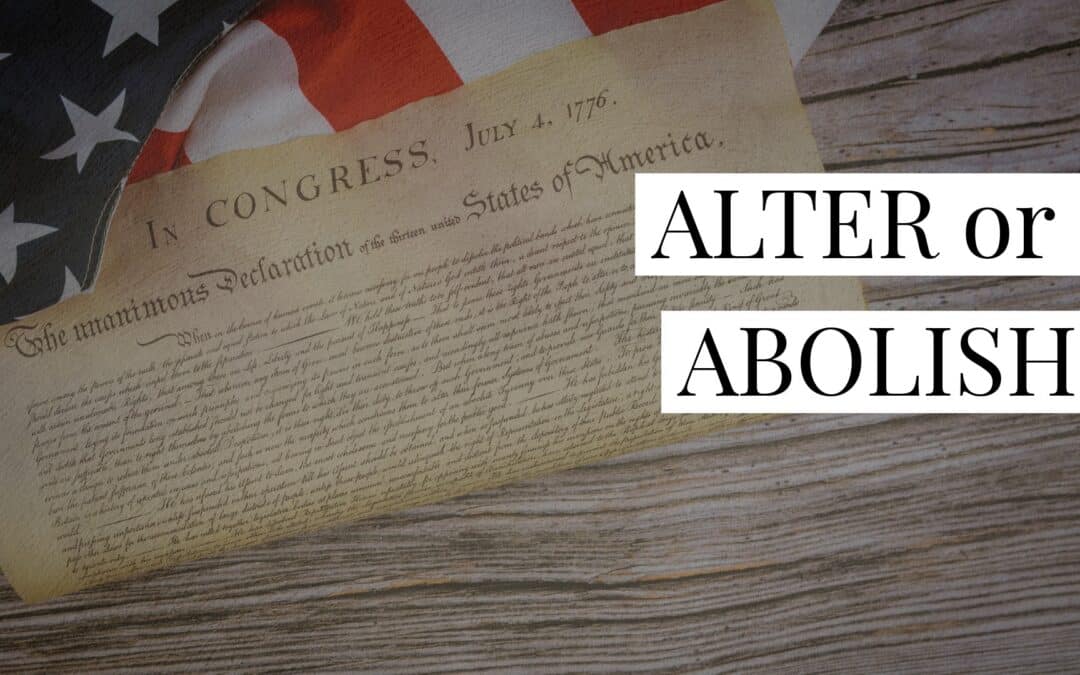
We hold these truths to be self-evident, that all men are created equal, that they are endowed by their Creator with certain unalienable Rights, that among these are Life, Liberty and the pursuit of Happiness. — That to secure these rights, Governments are instituted among Men, deriving their just powers from the consent of the governed, — That whenever any Form of Government becomes destructive of these ends, it is the Right of the People to alter or to abolish it, and to institute new Government, laying its foundation on such principles and organizing its powers in such form, as to them shall seem most likely to effect their Safety and Happiness

Our community and communities like ours around the state and nation must inspire others and it is our hope that with HR 61 these words will have a profound impact. In the words found on our Liberty Bell we must “Proclaim liberty throughout the land unto all the inhabitants thereof.”

I encourage you to visit my website at www.chrispeace.com and stay in touch with me and this committee to help me and my colleagues show support for the legislation in committee.   May god bless you and the USA

Delegate Christopher K. Peace represents the Virginia House of Delegates’ 97th District and serves on the prominent Courts of Justice, Health Welfare and Institutions, Science and Technology, and Finance Committees. The district spans parts of Hanover, Caroline, King William, King and Queen, Henrico, Spotsylvania Counties and all of New Kent County

Comments (10)

Tags: , ,

Liberty vs Power: The Battle Rages On

Posted on 22 September 2009 by Tenth Amendment

by Timothy Baldwin

The battles in America have almost gone unchanged since 1936 — and even, before. They are battles for the mind, the soul and the heart. They are battles of philosophy and understanding.

On May 26, 1936, constitutional professor of Princeton University, Edward Samuel Corwin, penned these words in his book, “The Commerce Power Verses States Rights: Back to the Constitution“:

“‘Back to the Constitution’ is the motto of this small volume, and by ‘Constitution’ is meant the Constitution of George Washington, Alexander Hamilton, James Madison (the Madison of 1787, not of 1798, nor of 1829), and of John Marshall; not the ‘interested sophistications’ of those later foster fathers of the Constitution, certain distinguished counsel who about 1890 began, with the too frequent aid of a sympathetic Court, to enmesh the powers of the National Government in ‘a network of juridical nicities’.” (Edward Samuel Corwin, “The Commerce Power Verses States Rights,” Preface, (Princeton University Press, 1936). Continue Reading

Comments (9)

Tags: , ,

The Sovereign Presidency: Is This What the Framers Had in Mind?

Posted on 20 September 2009 by Tenth Amendment

by Joseph R. Stromberg, The Freeman

American government under the Constitution was supposedly meant to work as follows: Congress, staying within delegated powers and the Bill of Rights, passes laws; the president executes the laws; and the courts sort out ensuing wrangles. This plan ran aground rather early—the 1798 Alien and Sedition Acts, for example—which raises at least two possibilities: 1) The Federalist movement systematically misrepresented its project or 2) the framers’ well-meant “design” fell short of their goals. Figuring this out is difficult, with original sin, human nature, foreign complications, and more tangling up the causal chain.

Even so, the Constitution—read anywhere near its apparent intent—might be worth hanging onto; but how can we get such a reading? Enter a new crop of “conservative” legalists to offer us one under the rubric of “originalism.”

For this crop of presidentialists, which includes John C. Yoo, Roger J. Delahunty, David Addington, Jay S. Bybee, and Attorney General Alberto Gonzales, originalism centers on the Unitary Executive Theory (UET)—a bizarre doctrine of presidential infallibility allegedly prefigured by Alexander Hamilton. Under the UET, America ’s president is utterly sovereign in his sphere and sole judge of his own powers.

The merest glance at America ’s founding suggests that no one really wanted full-bore elective despotism. Nonetheless, American presidentialists apparently find just that in the terms “war powers” and “commander-in-chief,” and in presidential dominance of foreign affairs. Yet their forebear Hamilton conceded that in war the president has “nothing more than the supreme command and direction of the military and naval forces, as first General and Admiral of the Confederacy” (Federalist 69).

Presidentialists take John Marshall’s comment, in Congress, that the president is our “sole organ of communication” with other nations as entailing lots of power. And always, presidents assert powers and store up precedents. Presidentialists turn presidential duties, chores, and everyday practices into powers, and strong figures have built the office. In the Mexican War (1846–48), President James Polk established the practical precedent of maneuvering Congress into war. But it was Abraham Lincoln, above all, who asserted immeasurable war powers belonging (mostly) to the president, by combining the commander-in-chief clause with the president’s job of enforcing the laws. Of this, legal historian Raoul Berger writes in Executive Privilege: “[W]hen nothing is added to nothing the sum remains nothing.” But success succeeds, and later presidents— Richard Nixon and George W. Bush among them—have eagerly wrapped themselves in Lincoln ’s mantle of effectively suspending the Constitution to save the country.

After Lincoln, presidential war powers rested up until 1898, when President William McKinley wielded them overseas. (McKinley issued a virtual ultimatum to Spain over Cuba a month before Congress declared war.) Theodore Roosevelt thought he could do anything not prohibited, at home and abroad, thereby neatly reversing the premise on which the Constitution was sold. Woodrow Wilson, too, had large views, but in 1917–1918 amiably shared with Congress the power of treading liberty under foot (conscription, for example), albeit with no new doctrines, merely existing bad ones.

Worse luck, in United States v. Curtiss-Wright Export Co. (1936), conservative Supreme Court Justice George Sutherland fancied that during our revolution, George III’s prerogative powers somehow lighted on the union, hovering, extra-constitutionally, above successive Congresses, descending finally on the presidency. Berger deconstructed Curtiss-Wright, underscoring the break with England and the resulting institutional discontinuity. Sutherland’s opinion stands, approvingly cited by UE theorists.

As Berger notes, Sutherland championed “a theory of inherent presidential power over foreign relations.” Berger quotes Louis Henkin, who adds that Sutherland’s assertion “carves a broad exception in the historic conception . . . never questioned and explicitly reaffirmed in the Tenth Amendment, that the federal government is one of enumerated powers only.”

Presidential power made great strides under Franklin Roosevelt, before and during World War II. FDR’s domestic emergencies and his wartime operations added much to the office. The Cold War extended these power-accumulations into an indefinite and interesting future.

The Supreme Court’s decision in Youngstown Sheet & Tube Co. v. Sawyer (1952), during the Korean War, reflected existing realities. Briefly, President Harry Truman, citing war powers, seized the steel industry to end a strike. People across the political spectrum, from organized labor to Republican Senator Robert Taft, denounced the action. The Supreme Court dodged the issue, holding that presidential powers did not go quite as far as Truman thought.

Bottomless Well of Power

Presidentialists take “The executive power shall be vested” (Article II) for a bottomless well. They see the specific duties mentioned as additional grants of power open to further (perhaps tortured) interpretation. They find further “inherent powers” arising from international law and Marshall’s sole organhood, and read the oath—“faithfully execute the office” and “preserve, protect, and defend the Constitution”—as allowing the president to violate laws in defense of the Constitution. Yet the charge that the president “take care that the laws be faithfully executed”(Article II, Section 3) seems to prohibit such maneuvers, although presidents have bent the words to their purposes, as when Lincoln “combined” them with the commander-in-chief provision.

Presidential lawyers aggregate or separate clauses to widen power. Political scientist Richard M. Pious writes in American Presidency that presidential lawyers, construing congressional powers strictly, view “all remaining functions, powers, and duties [as] exercised by the president under doctrines of inherent powers, resulting powers, sovereign powers, and inclusions”—along with emergency and national-security powers. Finally, presidents—as a branch of government—assert a right to interpret the Constitution. Pious shows minimal respect for these notions, commenting that recent, barely elected presidents have felt a need to exploit their “legal” opportunities.

From 1947 on, anticommunist crusading fostered right-wing presidentialism. Meanwhile, on other issues the Supreme Court provoked a reaction toward strict construction. Since that was quite incompatible with Cold War policies, something had to give; when it did, right-wing presidentialists hijacked strict construction, reinventing it as absolutist originalism. Midway through this journey, Richard Nixon’s cries of “national security”—to becloud the Watergate affair—rang like a fire bell in the day.

In his online paper “Rethinking Presidential Power—The Unitary Executive and the George W. Bush Presidency,” political scientist Christopher S. Kelley writes that, frustrated by ongoing congressional “aggression” against executive power—the War Powers Act of 1973 and congressional “interference” with federal bureaucracies—lawyers in the Justice Department’s Office of Legal Counsel cobbled UE theory together in the 1980s. During war—as everyone “knows”—the feds may freeze the Bill of Rights, provided they thaw it out later. What seems new in UE theory is the assertion that the president is sole judge of his powers, with Congress and courts excluded from inquiring into executive undertakings. (Nixon claimed to be sole judge of executive privilege.) This would seem a recipe for tyranny.

UE theorists speak of constitutional text, structure, and history; but their postmodern textual maneuvers, their homemade structures, and their lawyer’s history live on the edge of sudden implosion. In a 2003 paper, “Judicial Review and the War on Terrorism,” John Yoo, who had worked in the Bush 43 Office of Legal Counsel, asserted that while the judicial process exists for issues involving federalism, none exists for issues arising from war. He thereby nodded toward UE theorists’ oft-professed belief in states’ rights while separating all such “domestic” matters from important presidential activities. Yoo praised “the war powers system we have today in which the President initiates war, Congress funds it, and the courts remain aloof.” Further, the president may designate citizens as enemies, with no further proof or process needed.

Elsewhere, in “The President’s Constitutional Authority to Conduct Military Operations against Terrorist Organizations and the Nations that Harbor or Support Them,” Yoo and Roger Delahunty examine Article II of the Constitution where they see the mere words “the executive power shall be vested in a President”—the high-toned “Vesting Clause”—as unveiling a mighty fortress: “The executive power” (my emphasis). The authors assign the president “all of the executive power” and “full control“ of the military, adducing his power to “repel sudden attacks,” commending his “speed and energy.” Predictably, they hold that Congress has only powers “herein granted” and “enumerated,” while the president has “all other unenumerated powers.” Backed by “historical practice” and “precedent,” “the President alone” decides war and peace. This is textualism?

The shades of Wilson, FDR, and Truman must be smiling. Few non-White House supremacists would read texts so liberally. A whole generation of conservative constitutionalists now surpasses Earl Warren in creative writing. Some conservatives foment empire, militarism, surveillance, and presidential hubris through their own juridical and judicial activism.

Such are the raw materials of UET, but there are a few more points of interest.

Unenumerated Powers Don’t Exist

  1. Presidents reach for “all other unenumerated powers”; but by a well-known canon of construction, powers not enumerated are not “granted” and do not exist. The claim assumes the very thing to be proven. In Executive Privilege, Berger writes that, “lacking an ‘enumerated’ power, action is illegal” and observes that “faithfully executed” implies presidential accountability to Congress. Further, “executive privilege” (withholding information) asserts a power the King had already lost. He adds that “the Framers vested many prerogatives of the Crown in Congress and denied them to the President.”Berger remarks on the “meager scope” of the presidency’s projected powers: “The words ‘executive power’ were thus no more than a label designed to differentiate presidential from legislative functions, and to describe the powers thereafter conferred and enumerated. To derive additional authority from this descriptive label is to pervert the design of the Framers. . . .” Further: “Madison and [James] Wilson stated that the rights of ‘war and peace,’ enjoyed by the King, were not included in the ‘executive powers.’ Patently, the Framers were determined to cut all roots of the executive power in the royal prerogative.” Absent royal prerogative, the U.S. president would seem to be constitutionally impotent as far as finding and beginning his own wars goes. Practical politics made the office what it is today. In An Inquiry into the Principles and Policy of the Government of the United States (1814), John Taylor of Caroline, a serious strict constructionist, characterized the presidency as driving us toward “force and fraud” and “monarchy, revolution, and an iron government.” Election was an insufficient guard; for this reason the states put their executives under severe restrictions.
  2. Presidential lawyers dig out generalities about emergencies from Hamilton ’s Federalist essays but little on who holds the emergency powers. Is it Congress? As an executive officer under George Washington, Hamilton “discovered” what prerogative powers he could, and presidentialists get more mileage from this Hamilton. Given two Hamiltons, his arguments are somewhat suspect. (On prerogative powers in the Constitution, present or absent, see Forrest McDonald’s Novus Ordo Seclorum: The Intellectual Origins of the Constitution.)
    Precedent Yields No Right
  3. UE theorists dwell on text, practice, and precedent. But whether successful usurpations—some large, some microscopic—amend the Constitution is not proven. Presidents have gotten away with things. As Berger points out, presidential stonewalling, which Congress has resisted for two centuries, yields no “right” of executive privilege. Yet much rests on the larger implications of executive privilege where successfully asserted. In Construction Construed and Constitutions Vindicated (1820), Taylor noted that the Stuarts collected precedents “because, successive encroachments terminate in conquest.” Moreover: “precedents, both good and bad, ought to have weight. . . . But discrimination is as applicable to precedents, as to any other species of evidence . . . [and] no improvement in civil government has ever been made, or can be preserved, but by a subversion of precedents, until a form is discovered incapable of corruption.”
  4. UE theorists make much of the president’s job of repelling invasions of American soil. That this seldom happens is, for them, beside the point. Two much-mooted cases—Pearl Harbor and 9/11—drew forth no repelling. In 1846 President Polk was not repelling but was instead provoking. Nor was the Confederate attack on Fort Sumter, after months of talk, sudden, unexpected, or repelled. Given time, advocates might find some repelling, and so what? If the president failed to repel, defenders would still defend. Where is the mighty grant of “executive power”? Presidentialists hope to convince us that should a president ever defend American soil, he would be “making war,” thereby proving—apparently—that he may make war anywhere, anytime, at will. In “Emergency Powers and the Militia Acts,” legal scholar Stephen I. Vladeck does not concede a presidential power of repelling. Instead, such actions have rested on the Militia Acts of 1792, 1795, and 1807, and their successors, that is, on delegation by Congress. This greatly reduces what presidents can reasonably obtain from repelling. Indeed, they just break even with the states, which may “engage in war” when actually invaded.
  5. For UE theory, “separation of powers” works overtime, albeit rather cynically. Berger writes: “the separation of powers does not create or grant power; it only protects powers conferred by the Constitution. . . . [T]o argue from the bare fact of a tripartite system of government, without preliminary inquiry into the scope of each of the three powers, is like invoking the magic of numerology.”In any case, classic separation took “checks and balances” rather seriously. But if the president has his own sovereign sphere, how is he checked—or balanced.This brings us to John Taylor’s attack on “spherical sovereignty” in Construction Construed. (All emphasis has been added.) In McCulloch v. Maryland (1819), Chief Justice John Marshall sustained the supremacy of Congress in its sphere of action. Taylor agreed that “‘sphere’ conveys an idea of something limited,” but wondered “how this word . . . can be converted into a substantive uncircumscribed, by the help of the adjective ‘sovereign.’” He continues: “If the sovereignty of the spheres means any sovereignty at all, it supersedes the sovereignty of the people. . . .”Now Taylor is not objecting to spheres, but to sovereignty anywhere, since American principles demand actual delegation by real principals to real (and mere) agents. No one has “inherent” powers.Taylor continues: “There is no phrase in the constitution which even insinuates, that the actual divisions of power should be altered or impaired by incidental or implied powers.” Further: “Individual spheres or departments are easily persuaded, like Kings, that a subordination to themselves would be better for a nation, than the occasional collisions produced by a division and limitation of power.” And here was the danger: “A jurisdiction, limited by its own will, is an unlimited jurisdiction.”Taylor thought “occasional collisions” better than sovereign institutions. Rather than making Congress, executive, or court supreme in some realm, the Constitution created “co-ordinate political departments, intended as checks upon each other, only invested with defined and limited powers, and subjected to the sovereignty . . . of the people. . . . ”The Court’s new-fangled “spherical sovereignty” overthrew the division of powers: “A supreme power able to abolish collisions, is also able to abolish checks, and there can be no checks without collisions.” In America we “have preferred checks and collisions, to a dictatorship of one department. . . .” Under “the concurrent power of taxation,” Congress and the states “may each pass a law, both of which may be constitutional, and yet these laws may clash with, or impede each other. . . . For this clashing the constitution makes no provision.”

    According to Taylor , the Court was unearthing prerogative powers for Congress, including one to “remove all obstacles to its action.” Marshall sought “to unite an extension of power with an apparent adherence to the words of the constitution.” Under this dodge, “it was necessary to hook every implied, to some delegated power. . . .” This is still the practice of a continental state that micromanages the life-world under color of regulating commerce and passes worldwide military empire off as “defense.”

    On Taylor ’s reading, no branch derives sovereign powers from idealized separateness. Powers, where they exist, were delegated by living Americans, not by some cloud-borne eighteenth-century paragraphs “mediating” sovereignty to federal departments.

  6. UET’s “flexible system for going to war” (Yoo’s words) seems better fitted for finding and having wars than for actual defense of American soil. Here, where sovereignty and war powers conjure and conspire, UE theorists build on Marshall ’s gutting of enumerated powers and Sutherland’s “inherent” prerogatives; but Taylor whipped them before they were born, even on war powers:

    . . . [T]he case of war is specially provided for by the federal constitution, because the federal government, as having no sovereignty, could not other wise have declared it. . . . As the powers of making war and peace were necessary, it became necessary also to provide for them, not as emanations from the principle of a sovereignty in governments, but as delegated powers.. .. No powers in relation to war are derived from . . . sovereignty in governments under our system; and none can be justly inferred from the conclusions of the writers upon the laws of nations. . . .”[Emphasis supplied.]

    Presidential “signing statements,” grounded in UET, proclaim a departmental “reading” of what the president is signing into “law.” Unwilling to veto, President Bush says he will enforce the law (or not) as he sees fit. The attempt came before the name. In President: The Office and Powers, constitutional scholar Edward S. Corwin wrote of its having been undertaken in 1946–1947: “For a court to vary its interpretation of an act of Congress in deference to something said by the President at the time of signing would be . . . to endow him with a legislative power not shared by Congress.”

    Signing statements aim at influencing gullible jurists and, ultimately, at excluding the courts from even their normally feckless protection of liberty during alleged wars. (On this, see Richard E. Eliel’s “Freedom of Speech,” American Political Science Review, November 1924.)

Sovereignty, Unknown Powers, Strict Construction

If we forsake “originalism,” as we probably should, we need not give up strict construction. Any serious perspective must begin with contemporary comparisons of the Constitution as advertised with the Constitution as put into practice. Taylor, Spencer Roane, and others heard certain promises in the ratifying conventions and saw them broken once the promising parties were in office. Their critique rose from an unavoidable contrast. (For how quickly the Federalists’ real program emerged, see The Journal of William Maclay, U.S. senator from Pennsylvania , 1789–91, available online and in book form.)

In Construction Construed, Taylor went to the fundamentals. He began with “powers of sovereignty and supremacy [that] may be relished, because they tickle the mind with hopes and fears. . . .” Yet “the term ‘sovereignty,’ was sacrilegiously stolen from the attributes of God, and impiously assumed by Kings . . . [and] aristocracies and republicks have claimed the spoil.” In any case, the “idea of investing servants with sovereignty, and that of investing ourselves with a sovereignty over other nations, were equally preposterous.” (Now, of course, we do both.)

“Sovereignty” was “neither fiduciary nor capable of limitation.” In America, we “eradicate[d] it by establishing governments invested with specified and limited powers,” under which “the people or the states retain all the powers they have not bestowed . . . [and] ungranted rights remain also with the grantors . . . the people.” This canon of constitutional interpretation, by which powers “not granted” are seen as not granted—hence nonexistent—failed to impress Marshall and others. With more experience of the Constitution, we might judge Marshall wrong.

Taylor declined to see the words “To make all laws which shall be necessary and proper for carrying into execution the foregoing powers, and all other powers vested by this Constitution in the Government of the United States”( Article I, Section 8, 18) as a charter of unknown powers; Marshall, however, saw “necessary and proper” as licensing numberless convenient and apposite means, and alongside spherical sovereignty, this was his key innovation.

Lacking certain desired powers, Congress could not simply grasp them by calling them means “necessary and proper” for fulfilling actually enumerated powers. Before the Revolution, Taylor noted in Construction Construed, Parliament contended for unlimited means of war: “The colonies replied, that it would be more absurd to limit powers, and yet concede unlimited means for their execution . . . .” Marshall ’s repositioning of “means” undid the whole idea of enumeration. Taylor wrote: “As ends may be made to beget means, so means may be made to beget ends, until the co-habitation shall rear a progeny of unconstitutional bastards.”

Later court decisions have awarded the president the same “necessary and proper” latitude that it earlier gave Congress. The process is cumulative, but if the doctrine was unsound when aiding Congress, it remains so when fattening the executive.

Marshall undermined American political reasoning, said Taylor , “by inferring the powers of sovereignty from a delegated power; as the power of establishing banks, from the power of taxation . . . .” But reasoning from international law to American government was a mistake. Where foreign threats existed, “the constitution . . . disregarding . . . the laws of nations, assigns the power . . . to a department [Congress], not as being sovereign, but as being a trustee . . . [which] alone possesses a right to involve the United States in war; and no other department, nor any individual, has a better right to do so, than a constable has to bring the same calamity upon England. As the laws of nations cannot deprive congress of any power . . . so they cannot invest congress or any other department, with any power not bestowed by the constitution. . . . [Those laws] contemplate the powers of declaring war and making peace, as residing in an executive department; but the constitution divides them, and does not intrust the president with either” (emphasis supplied).

Contesting institutional sovereignty derived from international law, Taylor aimed right at UET theorists’ favorite things: the war powers and their location in the system.

Can Amendment Rid Us of This Turbulent Office?

Taylor ’s point is, very simply, that if the government has some general “sovereignty,” then it, or some branch of it, is the final judge of its actions. If the government is not sovereign, then the unknowably vast powers for war, emergencies, and so on must remain with the people, as individuals, families, or communities—a disturbing thought, even for believers in such powers. Such a theoretical placement might lead to individual civil disobedience and nullification by communities. Short of such drastic experiments, are there any constitutional cures for unitary-executive disease? Perhaps so. This brings us to our only remaining article of faith, the amending power.

Talk about unknown powers! We seem entirely free to abolish the executive in all its unitarity. Amendment, however, would require a train of disasters irrefutably stemming from that office. We have the disasters; the historical dice have been cast, but where will they land?

This article originally appeared in The Freeman - January 2007, Vol. 57, Issue 1.

Comments (7)

Tags: ,

The 10-4 Pledge for the Constitution

Posted on 17 September 2009 by Michael Boldin

Continue Reading

Comments (1)


Follow...


Sponsored Links


Sponsored Links


Tenth Amendment Pledge


Sponsored Links


Categories


Archives